

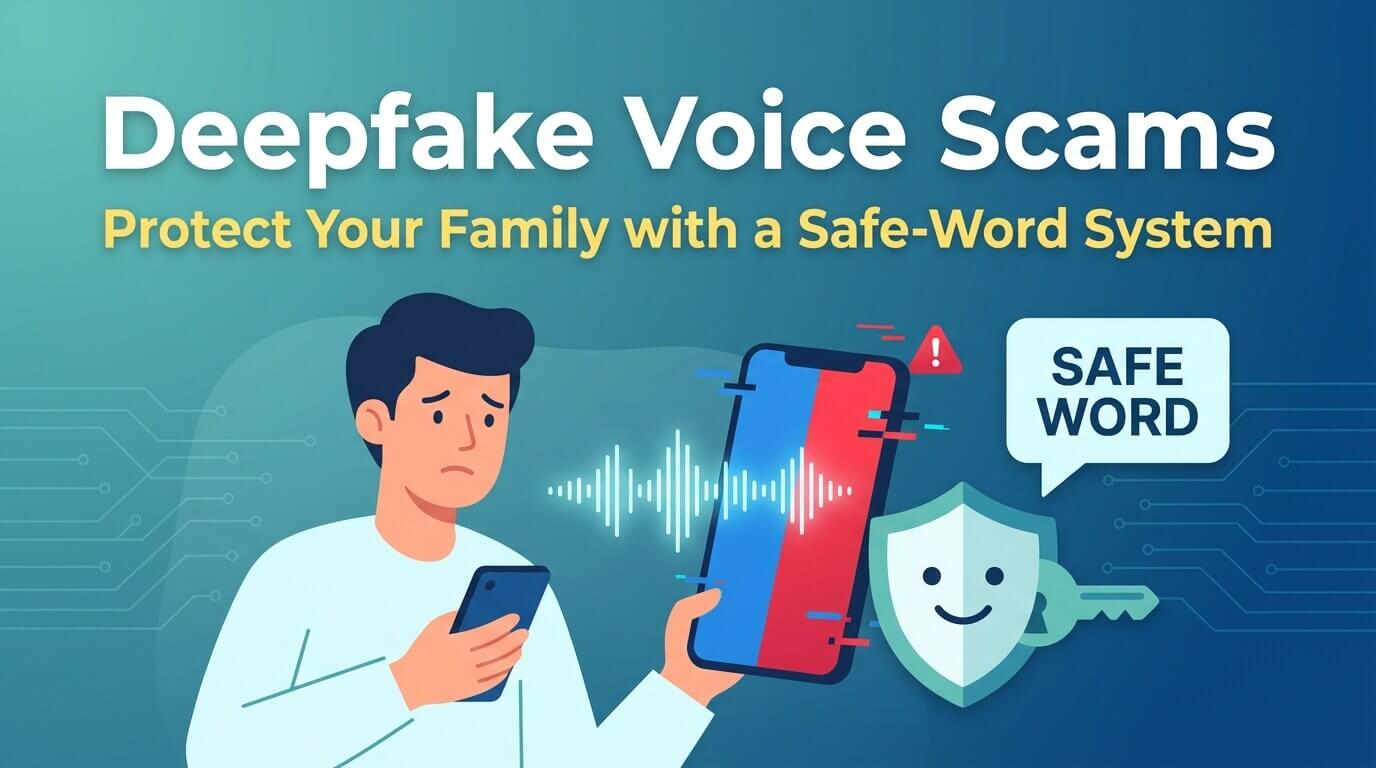
Your phone rings. It sounds exactly like your daughter, crying, saying she’s in trouble and needs money right now. Your heart drops, and that is exactly what the scammer is counting on.
AI voice-cloning tools have made this kind of call easier to fake. This guide explains how these scams work and gives you a simple four-step method, the SAFE method, plus a family safe-word system you can set up in about 10 minutes.
Quick Answer: How Do You Protect Your Family from Deepfake Voice Scams?
Agree on a private family safe word, and never send money based on a voice alone. If a call feels urgent, hang up and call the person back on their saved number. Real emergencies can survive a 60-second verification. Scams cannot.
Table of Contents
- What is a deepfake voice scam?
- How the scam works, step by step
- 7 red flags that give it away
- The SAFE method: what to do during the call
- How to set up a family safe word
- Family risk scorecard
- What to do if you already sent money
- FAQ
What Is a Deepfake Voice Scam?
A deepfake voice scam is a phone fraud in which the caller uses AI software to imitate the voice of someone you know, such as a child, parent, partner or boss. The goal is to rush you into sending money or sharing private information.
The U.S. Federal Trade Commission has warned that scammers can use voice cloning in “family emergency” schemes. Some cloning tools need only a short audio sample, and a social media video can be enough.
These calls are not always perfect, and the voice does not have to be perfect to work. A scammer only needs it to be believable for 30 seconds while you are scared.
How Does the Scam Work, Step by Step?
Step 1: The scammer collects a voice sample
Short clips from public videos, voicemails or social posts can be used as source audio.
Step 2: They gather personal details
Names, schools, workplaces and recent trips are often visible on public profiles. This is what makes the story sound real.
Step 3: They create panic
The typical story is an accident, an arrest, a kidnapping or a lost wallet abroad. The caller insists you must act immediately and tell no one.
Step 4: They demand hard-to-reverse payment
Common requests are gift cards, wire transfers, cryptocurrency or payment apps, because these are difficult to recover.
7 Red Flags That a Call Might Be an AI Voice Scam
- Extreme urgency: “You have to do this right now.”
- A request for secrecy: “Don’t tell Mom or Dad.”
- Unusual payment methods: gift cards, crypto, wire transfers.
- An unknown or spoofed number, or a “new phone” excuse.
- The caller avoids answering personal questions that only the real person would know.
- Strange audio: flat emotion, odd pauses, repeated phrases or a bad connection that hides flaws.
- A third person takes over, such as a “lawyer,” “police officer” or “kidnapper.”
The SAFE Method: What to Do During the Call
When you’re frightened, you won’t remember a long checklist. This four-letter method is easy to recall:
Letter |
Action |
What to say or do |
|---|---|---|
S |
Slow down |
Take one deep breath. Say, “Give me a moment.” |
A |
Ask for the safe word |
“What’s our family word?” A real family member knows it. |
F |
Flip the channel |
Hang up and call the person back on the number saved in your contacts, or message them on a different app. |
E |
Escalate and verify |
Contact another family member, the school, their workplace or local authorities to confirm. |
Illustrative example: imagine a caller says, “Mom, I crashed the car and I’m at the police station, I need $2,000 in gift cards.” Using SAFE, you slow down, ask for the safe word, hang up, and call your child’s saved number. Within a minute, you hear they’re sitting in class. The “emergency” is over because you checked.
How to Set Up a Family Safe Word (in 10 Minutes)
The 5 rules of a good safe word
- Make it random, not a pet’s name, birthday or street name. Anything findable on social media is weak.
- Use two or three unrelated words, such as “purple-ladder-mango.”
- Share it only in person or through a trusted private channel. Never post it in a public chat.
- Include everyone, especially grandparents and teenagers, who are common targets.
- Change it if it’s ever exposed, and review it every six months.
The 10-minute setup plan
- Minutes 1-3: Gather the family, in person or on a video call.
- Minutes 4-5: Pick the word together and say it out loud twice.
- Minutes 6-8: Practice one mock call. Let one person play the “caller” and see if everyone remembers to ask.
- Minutes 9-10: Agree on a backup rule: “If someone can’t give the word, we hang up and call back.”
What if someone forgets the safe word?
Treat it as unverified, not as proof of a scam. Use the “Flip the channel” step from SAFE. You can ask a question only the real person would know, though a safe word is more reliable than personal trivia, which scammers may find online.
Family Risk Scorecard: How Exposed Are You?
Give yourself one point for each statement that is true:
Statement |
Point |
|---|---|
We have no agreed family safe word. |
+1 |
Family members post public videos with clear voices. |
+1 |
A parent or grandparent lives alone and answers unknown numbers. |
+1 |
Social profiles show school, workplace or travel plans publicly. |
+1 |
We’ve never talked about scams as a family. |
+1 |
Our bank uses voice recognition as a main security step. |
+1 |
- 0-1 points: Low exposure. Keep your habits current.
- 2-3 points: Moderate exposure. Set up a safe word this week.
- 4-6 points: High exposure. Do the 10-minute plan today and review your privacy settings.
How Can You Reduce Your Voice Footprint Online?
- Set social media accounts to private or “friends only” where possible.
- Avoid posting long, clear voice clips publicly.
- Use a generic voicemail greeting instead of your own voice.
- Turn on your phone carrier’s spam-call filtering.
- Ask your bank about app-based or PIN verification instead of voice-only authentication.
None of these steps makes you immune, but together they make you a harder target.
What Should You Do If You Already Sent Money?
- Contact your bank or payment provider immediately. Fast action gives the best chance of stopping or recovering a transfer.
- Save evidence: phone numbers, call times, screenshots and receipts.
- Report it to your national fraud or cybercrime reporting portal, such as the FTC’s ReportFraud.ftc.gov in the United States or cybercrime.gov.in in India.
- Warn your family and friends, since the scammer may try again with another relative.
- Don’t feel ashamed. These scams are designed to fool smart, careful people.
Frequently Asked Questions
Can scammers really clone my voice from a short clip?
Some AI voice tools can produce a convincing imitation from a short sample. Quality varies, but a scammer only needs the voice to sound believable during a stressful call.
What is the best safe word for a family?
The best safe word is a random combination of two or three unrelated words that cannot be guessed or found online, shared in person, and known by every family member.
Should I answer calls from unknown numbers?
You don’t have to. Let unknown calls go to voicemail, then verify through a trusted channel. Real emergencies usually come with other ways to reach you.
Can deepfake scams target businesses too?
Yes. Scammers may imitate a manager or executive to request urgent payments. Businesses should require a second approval step for any unusual transfer.
What if the caller says “don’t hang up”?
That’s a major red flag. Hang up and call back on a number you trust. A genuine caller will understand.
Key Takeaways
- A familiar voice is no longer proof of identity.
- Use the SAFE method: Slow down, Ask for the safe word, Flip the channel, Escalate and verify.
- Set up a random family safe word and practice it once.
- Never send gift cards, crypto or wire transfers under pressure.
- Reduce your public voice footprint and talk about scams as a family.
Sources and Further Reading
- U.S. Federal Trade Commission: consumer alerts on family emergency scams and voice cloning (consumer.ftc.gov)
- ReportFraud.ftc.gov: official U.S. fraud reporting portal
- [Add your country’s official cybercrime or consumer protection page]