
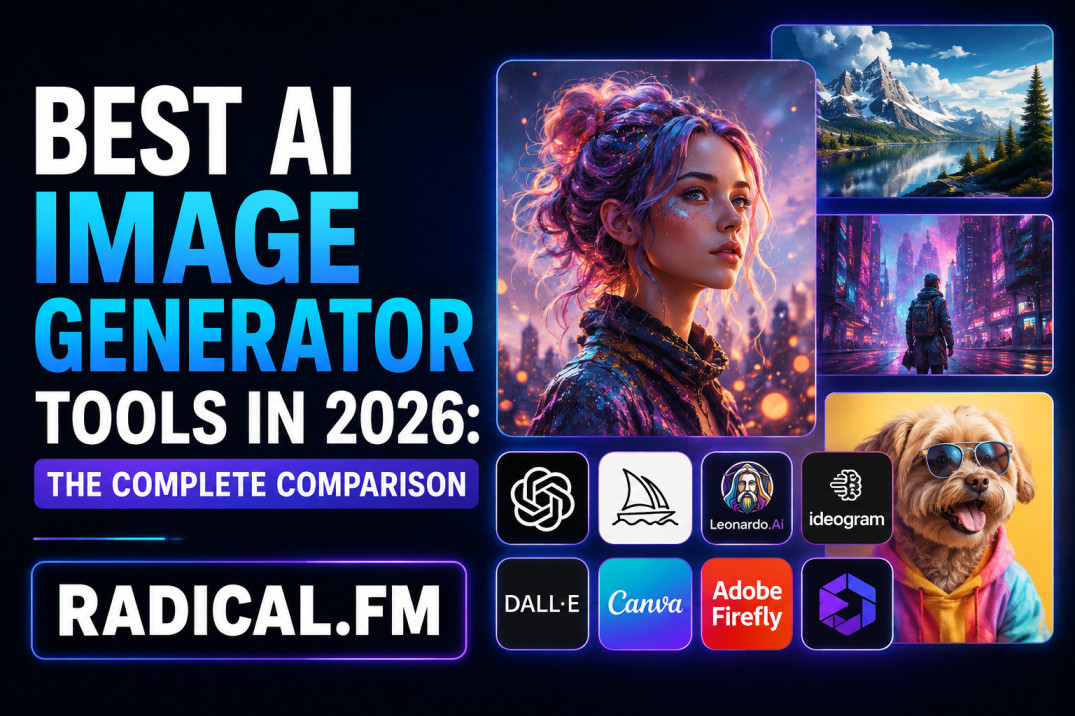
We tested and compared the 10 AI image generators actually worth your money in 2026 — from Midjourney’s photoreal renders to Google’s Nano Banana Pro and the open-source Flux/Stable Diffusion stack — so you don’t have to burn a subscription finding out which one fits your workflow.
⏱ 14 min read
🔍 10 tools reviewed
Table of Contents
⚡ Quick Picks
Best Overall
Google Nano Banana Pro
Best balance of text accuracy, reasoning, and price across casual and pro use.
Best for Artistic Quality
Midjourney V7
Still the photorealism and editorial-image benchmark, no serious rival.
Best Free Option
Leonardo.ai
150 daily tokens (20-30 images) forever, no watermark, real commercial use.
Best for Text in Images
Ideogram V4
Still the most reliable at rendering clean, legible typography inside a scene.
Best for Commercial Safety
Adobe Firefly
Trained on licensed content only, with IP indemnification built into every plan.
📊 Comparison Table
Tool |
Price |
Free Plan |
Best For |
Key Feature |
|---|---|---|---|---|
Nano Banana Pro (Google) |
API: $0.134–$0.24/img · Gemini AI Plus $19.99/mo |
Yes, limited daily quota in Gemini app |
Infographics, text-heavy graphics, reasoning-based edits |
Search-grounded generation, 14-image reference consistency |
Midjourney V7 / V8.1 |
$10 / $30 / $60 / $120 per mo |
None |
Artistic, editorial, and photoreal imagery |
Omni Reference for character/style consistency |
Adobe Firefly |
Free / $9.99 / $19.99 / $49.99+ per mo |
Yes, ~25 credits/mo |
Brand-safe marketing teams on Creative Cloud |
IP indemnification + Photoshop Generative Fill |
Ideogram V4 |
Free / $8 / $20 / $48 per mo |
Yes, 10 slow gens/day |
Posters, logos, ads with readable text |
Magic Prompt auto-enhancement + Remix mode |
Recraft V3 |
Free / $10–$12 / $25–$27 / $48 per mo |
Yes, 50 credits/day (no commercial rights) |
Brand systems, icons, native vector/SVG output |
Only major tool generating true scalable SVGs |
Leonardo.ai |
Free / $12 / $30 / $60 per mo |
Yes, 150 tokens/day (~20-30 images) |
Concept art, game assets, multi-model access |
One subscription surfaces Flux, Nano Banana Pro, Ideogram, Seedream |
ChatGPT (GPT Image 2) |
Free / Plus $20 / Pro $200 per mo |
Yes, limited daily generations |
Conversational, in-chat image requests |
Iterative editing through natural-language follow-ups |
Canva Magic Media |
Free / Pro $15/mo |
Yes, basic generation included |
Non-designers who need images inside finished layouts |
Generation lives inside the same editor as templates/social posts |
Flux 2 (Black Forest Labs) |
API from $0.03/megapixel · free if self-hosted |
Yes, via open weights (Dev/Schnell) |
Developers, photorealism at scale, custom pipelines |
Open-weight tiers you can fine-tune and run locally |
Stable Diffusion (SDXL/SD3.5) |
Free self-hosted · cloud API $0.02–$0.10/img |
Yes, fully free if self-hosted |
Full control, no vendor lock-in, community models |
Thousands of community fine-tunes and ControlNet extensions |
Reve |
Free tier + ~$0.01/edit via API |
Yes, free tier in first-party app |
Prompt-accurate iterative editing |
Cheap, granular per-edit billing instead of per-image |
Pricing verified against vendor pages and third-party trackers as of August 2026. AI pricing changes fast — confirm current rates before buying.
🔍 Detailed Reviews
1
Google Nano Banana Pro (Gemini 3 Pro Image)
From $0.134/img · $19.99/mo app
Best for: text-heavy graphics, infographics, and edits that need real-world knowledge baked in
Nano Banana Pro is Google’s Gemini 3 Pro Image model, and it’s the first image generator that genuinely “thinks” before drawing — it reasons about the prompt using the same model that powers Gemini’s chat, which is why it renders legible paragraphs of text, keeps facts straight in diagrams, and holds a character consistent across up to 14 reference images. The faster, cheaper sibling, Nano Banana 2, trades some of that reasoning depth for 3x lower cost and near-instant generation, making it the better pick for high-volume ad variation testing.
✓ PROS
- Best-in-class text rendering inside images
- Search-grounded facts for diagrams/infographics
- Cheapest frontier-quality API per image
✗ CONS
- Pricing split across API, Gemini app, and Vertex AI is confusing
- No dedicated standalone subscription — it’s bundled into Google AI plans
- Every output carries a visible SynthID watermark
2
Midjourney V7 / V8.1
$10–$120/mo
Best for: artistic direction, editorial imagery, and anyone who needs the image to look “designed”
Midjourney remains the photorealism and aesthetic benchmark heading into late 2026. V7’s Omni Reference feature replaced the old character-reference workaround with a proper system for locking a subject’s face, outfit, or style across a whole set of generations, closing the consistency gap against Nano Banana and DALL-E-style tools. There’s no free trial — Basic starts at $10/month and only buys you 3.3 hours of Fast GPU time, so casual users burn through it faster than the sticker price suggests.
✓ PROS
- Unmatched artistic and photoreal aesthetic quality
- Omni Reference locks character/style across a whole set
- Native web app now — Discord no longer required
✗ CONS
- No free tier at all, ever
- Billed in GPU-time, not image count — easy to underestimate cost
- Weak at rendering readable text inside images
3
Adobe Firefly
Free–$49.99+/mo
Best for: brand-safe marketing teams already inside Creative Cloud
Firefly’s entire pitch is legal safety: it’s trained exclusively on licensed Adobe Stock and public-domain content, and every paid plan ships with IP indemnification — meaning Adobe will cover you if a generated image somehow triggers a copyright claim. That’s rare among competitors and it’s why brand and legal teams default to Firefly even when the raw output quality trails Midjourney. Standard at $9.99/month includes unlimited standard-quality generations, with credits only burning on premium features like video or third-party model access.
✓ PROS
- IP indemnification on every paid tier
- Deep native integration with Photoshop and Illustrator
- Unlimited standard generations from just $9.99/mo
✗ CONS
- Raw aesthetic quality trails Midjourney and Nano Banana Pro
- Premium credits (video, generative extend) drain fast
- New model updates roll out slower than independent labs
4
Ideogram V4
Free–$48/mo
Best for: posters, packaging mockups, logo concepts, and anything where the words in the image matter
Ideogram carved out its niche by solving the one thing most diffusion models still struggle with: spelling. It reliably renders multi-word headlines, product labels, and logo lettering without garbled characters, which is why designers reach for it specifically for text-in-image work rather than general art. On raw per-image cost it sits above Recraft on the Default tier but undercuts it on the faster Turbo tier, and there’s no free tier on the developer API — only the consumer app gives you 10 slow generations a day at no cost.
✓ PROS
- Industry-leading text/typography accuracy
- Magic Prompt turns a short idea into a full detailed prompt
- Remix mode makes iterating on an existing image fast
✗ CONS
- No free tier on the API — every call is billed
- General artistic quality is a step behind Midjourney
- Free consumer tier limited to 10 slow generations/day
5
Recraft V3
Free–$48/mo
Best for: brand systems, icon sets, and any deliverable that needs to actually be a vector file
Recraft is the only mainstream tool that generates genuine scalable SVG vectors from a prompt instead of a raster image dressed up to look like one — a real advantage for logo concepts, icon sets, and brand assets that need to scale cleanly. The free plan’s catch is ownership: those 50 daily credits produce public images that Recraft itself retains rights to, so anything client-facing needs at least the $10–12/month Basic tier for private generation and commercial rights.
✓ PROS
- Only major tool producing true native SVG vectors
- Strong brand-consistency and color-palette controls
- Cheapest per-raster-image cost among paid tools (~$0.01–0.012)
✗ CONS
- Free-tier outputs are public with no commercial license
- Vector files often need manual anchor-point cleanup
- Credit system (1 credit = raster, 2 = vector) takes getting used to
6
Leonardo.ai
Free–$60/mo
Best for: concept artists, game developers, and anyone who wants one subscription to reach multiple models
Since Canva’s 2024 acquisition, Leonardo has quietly become a multi-model hub rather than a single-model tool — its own Lucid Origin/Realism and Phoenix models sit alongside surfaced access to Flux 2 Pro, Nano Banana Pro, Ideogram, and Seedream 4.5, all metered through one shared “Fast Token” currency. If your team already pays for Canva Business, the $12 Essential tier comes bundled at no extra cost, which is the single biggest hidden value in this whole list.
✓ PROS
- Genuine free tier (150 tokens/day) with no watermark
- One subscription reaches Flux, Ideogram, Nano Banana Pro and more
- Bundled free with Canva Business plans
✗ CONS
- No vector/SVG output
- Token system has a learning curve — easy to burn through fast
- “Unlimited” label excludes third-party models and video
7
ChatGPT (GPT Image 2)
Free–$200/mo
Best for: people who want to describe an edit in plain language rather than learn a prompting syntax
OpenAI folded image generation directly into ChatGPT’s chat window, which makes it the least intimidating entry point on this list — you just describe what you want, and if it’s wrong you tell it what to fix in the next message instead of rewriting a prompt from scratch. Worth noting: OpenAI retired the standalone DALL·E 3 API in May 2026, so GPT Image 2 (accessed through ChatGPT or the Images API) is now the only path in.
✓ PROS
- Lowest learning curve of any tool on this list
- Conversational, multi-turn editing in plain English
- API pricing scales down to $0.006/image at low quality for bulk jobs
✗ CONS
- Less fine-grained creative control than Midjourney or Leonardo
- Free tier generation limits are tight and reset unpredictably
- DALL·E 3 API is now retired — legacy integrations need migrating
8
Canva Magic Media
Free / $15/mo
Best for: non-designers who need an image dropped straight into a finished social post, deck, or flyer
Canva doesn’t try to compete on raw model quality — Magic Media generation sits inside the same editor as its templates, so the image you generate is already positioned on a layout with text, brand colors, and export sizing handled. That workflow integration is the whole value proposition; if you compare it purely on image fidelity against Midjourney or Nano Banana Pro, it loses. For solo creators and small teams doing marketing collateral rather than fine art, that trade-off is usually the right one.
✓ PROS
- Generation happens directly inside finished layouts
- Cheapest all-in-one plan on this list at $15/month
- Zero learning curve for anyone who already uses Canva
✗ CONS
- Underlying model quality trails dedicated image tools
- Not built for fine-grained prompt control or iteration
- Best features (brand kit, templates) require the Pro plan anyway
9
Flux 2 (Black Forest Labs)
$0.03–$0.07/megapixel · free open weights
Best for: developers and technical teams who want frontier photorealism without a subscription wrapper
Flux, built by the ex-Stability AI team at Black Forest Labs, has become the photorealism reference point for anyone building a custom pipeline rather than using a consumer app. It ships in tiers: Pro and Max as hosted paid APIs billed per megapixel, and Dev/Schnell as open-weight models you can download and run yourself for free (or fine-tune on your own hardware). That flexibility is also the catch — there’s no polished consumer interface, so you’re either calling an API or setting up ComfyUI/Automatic1111 yourself.
✓ PROS
- Among the best raw photorealism of any model tested
- Open-weight tiers are genuinely free to self-host
- Per-megapixel billing scales cleanly for bulk production
✗ CONS
- No consumer-friendly app of its own
- Self-hosting requires real GPU hardware or cloud spend
- Weaker at in-image text than Ideogram or Nano Banana Pro
10
Stable Diffusion (SDXL / SD 3.5)
Free self-hosted · API $0.02–$0.10/img
Best for: full control, no per-image billing, and teams that want to own their generation pipeline
Stable Diffusion is the reason “open-source AI image generation” is a meaningful category at all. It trails Midjourney and Flux on out-of-the-box raw quality, but its real strength is the ecosystem: thousands of community fine-tunes, ControlNet extensions for pose and composition control, and LoRA training for locking in a specific character or style — none of which require paying a subscription. If you have the hardware (or budget for cloud GPU rental), it’s the only tool here with zero per-image marginal cost.
✓ PROS
- Genuinely free and open-license when self-hosted
- Enormous community model and ControlNet ecosystem
- Full control over training data and fine-tuning
✗ CONS
- Steep technical setup (ComfyUI, Automatic1111, VRAM requirements)
- Out-of-the-box quality trails Flux and Midjourney
- No official polished consumer app — quality depends on your setup
🧭 How to Choose
1. Does the image need to include readable text?
If yes, go straight to Ideogram or Nano Banana Pro — every other tool on this list will garble multi-word text more often than not.
2. Do you need airtight commercial/legal safety?
Adobe Firefly is the only tool here with formal IP indemnification bundled into every paid plan — worth it for regulated brands and agencies.
3. Is the final asset a logo, icon, or brand system?
Only Recraft outputs true editable vector SVGs — every other tool gives you a raster image, even for “logo” prompts.
4. How much monthly volume are you actually generating?
Under ~50 images/month, free tiers (Leonardo, Ideogram, Recraft) cover you. Past a few hundred/month, per-image API pricing (Flux, Nano Banana 2, Imagen) usually beats a flat subscription.
5. Do you want one model or access to many?
Leonardo bundles Flux, Ideogram, Nano Banana Pro and its own models under one subscription — useful if you don’t want to juggle five logins.
📈 2026 Trends
01
Reasoning models replace pure diffusion
Nano Banana Pro’s “think before you draw” approach is pushing competitors to add real-world knowledge and logic to image generation, not just pattern-matching pixels.
02
Per-image API pricing keeps dropping
Frontier-quality generation now starts around $0.02-$0.06/image via API, a fraction of 2024 rates, making high-volume ad and e-commerce generation economically viable.
03
Multi-model platforms over single-model apps
Leonardo, and aggregators like it, now surface Flux, Ideogram, and Nano Banana Pro through one login — consumers increasingly want model choice, not model loyalty.
04
Text rendering has stopped being a weakness
What was a universal failure point in 2023-2024 (garbled letters) is now solved reliably by Ideogram, Nano Banana Pro, and Recraft — legible in-image typography is table stakes now.
05
Consolidation through acquisition
Canva’s 2024 acquisition of Leonardo signaled a wave of design-suite vendors buying standalone generators rather than building their own from scratch.
06
Watermarking is becoming standard practice
Google’s SynthID on every Nano Banana output reflects a broader industry shift toward invisible provenance markers as AI-image detection regulation tightens globally.
❓ Frequently Asked Questions
Which AI image generator is best for beginners?
ChatGPT and Canva Magic Media have the shortest learning curve because you describe what you want in plain language instead of learning prompt syntax. Leonardo’s free tier is a close third if you want more creative control without a steep learning cost.
Is Midjourney still worth paying for in 2026?
Yes, if artistic and photoreal quality is the priority — it remains the aesthetic benchmark. It’s less compelling if you mainly need text-in-image accuracy or a free tier, where Nano Banana Pro or Ideogram fit better.
Can I use AI-generated images commercially?
Most paid plans grant commercial usage rights, but terms vary by tool — check carefully. Recraft and some free tiers explicitly retain ownership of free-generated images, and only Adobe Firefly currently offers formal IP indemnification against copyright claims.
Which tool is best for generating text inside images (posters, logos)?
Ideogram remains the most reliable for multi-word, legible text. Nano Banana Pro is a close second and better when the text needs to be factually accurate, like in infographics or diagrams.
What’s the cheapest way to generate AI images at high volume?
Self-hosted Stable Diffusion or Flux (open-weight tiers) have zero per-image marginal cost if you already have GPU hardware. For hosted options without hardware, per-image APIs like Nano Banana 2 or Flux Pro (roughly $0.02-$0.07/image) beat flat subscriptions once you’re past a few hundred images a month.
Do any of these tools generate true vector graphics?
Only Recraft generates genuine scalable SVG output directly from a text prompt. Every other tool on this list produces raster images (PNG/JPEG), even when the prompt asks for a “vector logo.”
Is Stable Diffusion still relevant with so many closed-model competitors?
Yes, particularly for teams that need full control over training data, want to fine-tune on proprietary imagery, or want zero per-image billing. It requires more technical setup than any closed tool on this list, but the open ecosystem (ControlNet, LoRA, community models) is unmatched.
What happened to DALL-E 3?
OpenAI retired the standalone DALL·E 3 API in May 2026. Image generation now runs through GPT Image 2, accessible via ChatGPT or OpenAI’s Images API — the underlying capability didn’t disappear, but the specific model and endpoint name did.
Should I pick one tool or subscribe to several?
Most individual creators do fine with one primary tool plus a free-tier backup for edge cases (e.g., Midjourney for art, Ideogram’s free tier for the occasional text-heavy graphic). Agencies and teams producing high volume across varied use cases often justify a multi-model platform like Leonardo instead of stacking separate subscriptions.
🎯 Final Recommendations
👤 Solo content creator / blogger
Leonardo.ai free tier + Ideogram free tier. Covers general illustration and text-heavy graphics without spending a dollar.
🏢 Marketing team / SMB
Adobe Firefly ($9.99/mo) + Canva Pro ($15/mo). Legal safety for client-facing work plus fast layout-ready social content.
🎨 Independent artist / illustrator
Midjourney Standard ($30/mo). Best aesthetic ceiling, unlimited Relax Mode once Fast hours run out.
🧑💻 Developer building a product
Flux 2 API + Nano Banana 2 API. Pay-per-image billing that scales with usage, no subscription lock-in.
🏷️ Brand / design agency
Recraft Pro ($25–27/mo) + Adobe Firefly Standard. Native vector output for identity systems plus indemnified imagery for campaigns.
🕹️ Game studio / concept art team
Leonardo Premium ($30/mo) + self-hosted Stable Diffusion. Fast iteration on Leonardo, full training control on your own SD pipeline.
Pricing and feature details verified against official vendor pages and third-party trackers as of August 21, 2026. AI tool pricing changes frequently — always confirm current rates on the vendor’s site before subscribing.