

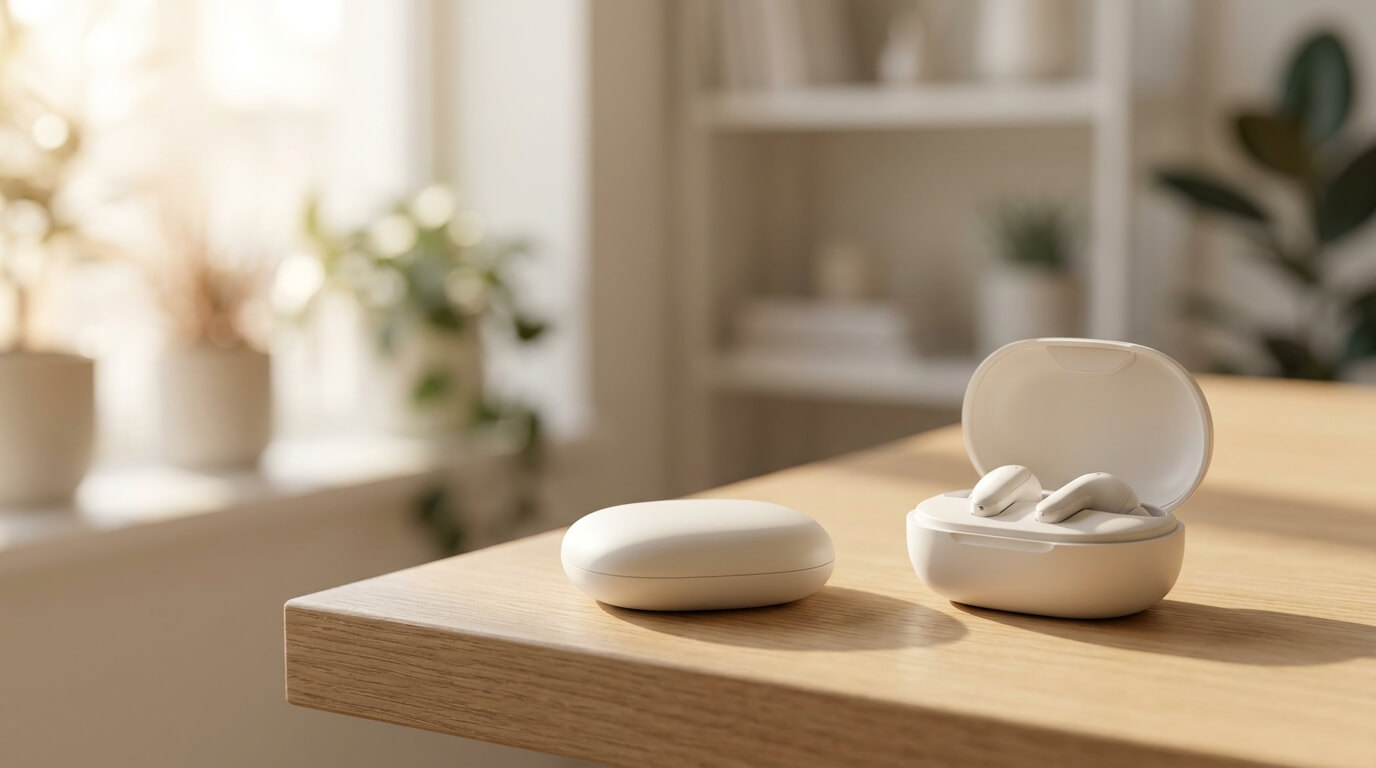
OpenAI is building a screenless, voice-first AI device with former Apple design chief Jony Ive, following its $6.4 billion acquisition of Ive’s hardware startup io in May 2025. The first product to actually ship looks to be a smart speaker with a built-in camera and facial recognition, priced between $200 and $300, targeting an early 2027 launch. But OpenAI is reportedly racing on multiple fronts at once: an earbud codenamed “Sweetpea,” a pen-shaped wearable called “Gumdrop,” and as of May 2026, a fast-tracked “AI agent phone” that could enter mass production in the first half of 2027. Sam Altman calls it the “coolest piece of technology the world will have ever seen.” Nobody outside OpenAI has held one yet.
This guide breaks down every confirmed detail, every credible leak, and what it actually means for you, whether you’re a consumer wondering what to buy next or a business trying to plan for what’s coming.
1. What Exactly Is OpenAI’s Jony Ive Device?
It’s not one device. It’s a family of hardware projects, all built around the same idea: AI you talk to, not AI you tap through a screen. OpenAI’s leadership has been unusually blunt that they don’t want to make “just another smartphone.”
The project traces back to OpenAI’s acquisition of io Products, the hardware company Jony Ive co-founded after leaving Apple in 2019. That deal folded roughly 55 hardware and design specialists into OpenAI, with Ive himself taking on design responsibility across the company while keeping his studio, LoveFrom, independent.
- No traditional screen — interaction happens mostly through voice and ambient sensing
- Runs OpenAI’s own models natively for persistent memory and context
- Designed to feel “calm” rather than attention-grabbing, according to Altman and Ive
- Multiple form factors in development at once, not a single product
2. The $6.4 Billion Deal That Started Everything
Sam Altman and Jony Ive didn’t start this partnership the day the acquisition was announced. Reports indicate the two had been quietly meeting and prototyping for close to two years before it became public in May 2025.
The deal itself was structured as an all-stock transaction, and most current reporting puts the value at roughly $6.4 billion, one of the largest acquisitions in OpenAI’s history. In their joint announcement letter, Altman and Ive described the collaboration as something that grew from “friendship, curiosity and shared values” into a genuine product roadmap.
- io Products merged fully into OpenAI; Ive took on deep creative responsibility across the company
- LoveFrom, Ive’s design studio, remains legally independent but supplies hardware designs
- Former Apple designer Evans Hankey now leads industrial design on the project
- Other ex-Apple hires, including Tang Tan and Scott Cannon, are working on the hardware team
3. What the Hardware Might Actually Look Like
This is the part where rumors get specific enough to feel real. Multiple form factors are apparently being tested in parallel, and not all of them will make it to market.
The earbud, reportedly codenamed “Sweetpea,” is described as having a design distinct from AirPods, built for constant ambient listening rather than just music. A separate pen-shaped concept, nicknamed “Gumdrop,” has also surfaced in supply chain chatter, though details remain thin. Then there’s the smart speaker, the one with the most concrete specifications so far.
- Sweetpea: earbud-style wearable, always-listening design, earliest to potentially ship
- Gumdrop: pen-shaped device, purpose still unclear, likely a secondary form factor
- Smart speaker: camera-equipped, home-based, most fully specified product to date
- Smart glasses and a smart lamp are reportedly on the roadmap for 2028 or later
4. The Smart Speaker: OpenAI’s First Confirmed Product
Of everything reported, the smart speaker has the most detail attached to it, likely because it’s furthest along in development. According to reporting from The Information, this could be the very first OpenAI hardware product to reach store shelves.
The speaker reportedly includes an integrated camera with facial recognition, similar in concept to Face ID, so it can identify who’s talking to it. Internal OpenAI presentations reportedly described the device observing user routines and proactively suggesting actions, like recommending an earlier bedtime before a big morning meeting.
- Integrated camera with facial-recognition-style user identification
- Designed to support voice purchases and everyday requests
- Proactive suggestions based on observed habits and context
- Expected retail price: $200–$300
- Earliest planned launch window: February 2027
5. The Timeline: When Can You Actually Buy One?
If the timeline feels like it keeps moving, that’s because it has. Different OpenAI executives and different leaks have pointed to different windows, and the company itself hasn’t committed to a firm date.
At Davos in January 2026, OpenAI’s chief global affairs officer Chris Lehane said the company was “on track” to unveil its first device in the second half of 2026, while stopping short of promising it would go on sale that year. By May 2026, analyst Ming-Chi Kuo reported OpenAI was fast-tracking a phone-like “AI agent” device for mass production as early as the first half of 2027, a notably faster pace than earlier reporting suggested.
- H2 2026: most likely window for a public unveiling or reveal event
- Early 2027: target launch for the camera-equipped smart speaker
- H1 2027: fast-tracked mass production window reported for an AI phone concept
- 2028 or later: smart glasses and smart lamp, still in early exploration
6. Why This Might Succeed Where Humane and Rabbit Failed
AI hardware has a rough track record. The Humane AI Pin launched in 2024 to scathing reviews and was eventually sold off. The Rabbit R1 generated buzz, then faded fast once people realized it couldn’t do much a phone app couldn’t already do.
Both devices shared the same core problem: the underlying AI wasn’t good enough to justify carrying a separate gadget. OpenAI’s argument is that this problem is now mostly solved, models like GPT-5.5 and the newly previewed GPT-5.6 series are dramatically more capable than what powered those earlier flops, which shifts the challenge from “can the AI do this” to “does the object feel good to use.”
- Humane AI Pin: overheating issues, laggy AI, discontinued and sold to HP
- Rabbit R1: hype-driven launch, limited real functionality, quick decline in interest
- OpenAI’s bet: model capability is no longer the bottleneck, industrial design is
- Ive’s three-decade design track record is the specific asset meant to solve that gap
7. The Manufacturing Race Behind the Scenes
Building tens of millions of a brand-new device category is a very different problem than building software. OpenAI’s manufacturing plans have shifted at least once already, which tells you how early-stage this still is.
Early reporting linked OpenAI to China’s Luxshare for production, but more recent reports indicate a shift toward Foxconn, the same manufacturer behind most Apple devices, with production potentially based in the U.S. or Vietnam. Reported first-year production targets sit at roughly 40 to 50 million units, an extremely ambitious number for a company that has never shipped consumer hardware before.
- Manufacturing partner reportedly shifted from Luxshare toward Foxconn
- Production location reportedly being explored in the U.S. and Vietnam
- Target of 40–50 million units in year one, if reports hold
- OpenAI has also hired Apple veterans, including Vision Pro engineering lead Paul Meade, to build out the hardware team
8. What This Means for Apple, Google, and Your Next Phone
The smartphone industry has had exactly one real disruption in the last two decades, and Apple was on the winning side of it. OpenAI’s hardware push is the clearest sign yet that it wants to be on the winning side of the next one.
Apple isn’t standing still either, it has its own home hub device in development, and it just lost a senior Vision Pro engineering leader to OpenAI in June 2026. Meanwhile, Meta’s Ray-Ban smart glasses already control a reported 75–80% share of the AI glasses category, showing that ambient AI hardware is not a hypothetical market, it’s already being fought over.
- Apple is developing a competing home hub device with its own camera and Siri integration
- Meta already dominates AI smart glasses market share heading into 2026
- OpenAI’s device strategy is about controlling hardware, software, and models end to end
- Enterprises should expect AI agents to increasingly act across devices, not just inside apps
9. Real-World Examples: How People Might Actually Use This
It’s easy to talk about “ambient AI” in the abstract. Here’s what the reported feature set actually translates to in daily use, based on what OpenAI has shown employees internally.
A parent gets a gentle nudge to head to bed earlier because the device noticed an early meeting on their calendar. A shopper asks the speaker to reorder a product by voice, and it recognizes their face to confirm the purchase without pulling out a wallet or phone. A remote worker wearing the Sweetpea earbud gets a whispered summary of a message instead of glancing at a screen mid-conversation.
- Grocery and household reordering handled entirely by voice and facial recognition
- Proactive scheduling nudges based on calendar and observed routine
- Hands-free message summaries delivered through an always-on earbud
- Sales and knowledge workers potentially freed from switching between apps to get context
Frequently Asked Questions
What is OpenAI’s Jony Ive AI device called? No official product name has been confirmed. Reported internal codenames include “Sweetpea” for an earbud concept and “Gumdrop” for a pen-shaped device, alongside an unnamed camera-equipped smart speaker.
How much did OpenAI pay for Jony Ive’s company? OpenAI acquired io Products in an all-stock deal, with most current reporting valuing the transaction at approximately $6.4 billion, announced in May 2025.
When is the OpenAI device coming out? OpenAI’s chief global affairs officer said the company is targeting a reveal in the second half of 2026, with the camera-equipped smart speaker expected to actually go on sale as early as February 2027.
Will the device have a screen? Reporting consistently indicates no traditional screen, or at most a minimal one. The interaction model relies primarily on voice and ambient sensing rather than a display.
How is this different from the Humane AI Pin? The core difference is AI capability. The Humane AI Pin launched with underlying models that weren’t strong enough to justify a standalone device, while OpenAI’s current models are significantly more capable, shifting the challenge to industrial design rather than raw AI performance.
Will OpenAI’s device replace the iPhone? OpenAI has publicly avoided framing it as a direct smartphone replacement, describing it instead as a new device category. That said, a fast-tracked “AI agent phone” reported in May 2026 suggests OpenAI is at least exploring more direct phone-category competition.
Who is manufacturing the OpenAI device? Reports have shifted from an early partnership with China’s Luxshare toward Foxconn, the manufacturer behind most Apple products, with reported production targets of 40 to 50 million units in the first year.
How much will it cost? The camera-equipped smart speaker is reportedly expected to be priced between $200 and $300. Pricing for the earbud, pen device, or any phone-style product has not been reported.
The Bottom Line
OpenAI’s hardware bet is no longer a rumor confined to leaked slide decks, it’s a multi-device roadmap with real manufacturing partners, real hires, and a real (if shifting) timeline. The smart speaker looks like the first product to actually reach your kitchen counter, likely in early 2027, with earbuds, a pen-shaped device, and even a fast-tracked phone concept trailing behind it.
Whether this becomes the next iPhone moment or the next Humane AI Pin depends entirely on execution and on whether Jony Ive’s design instincts can finally make ambient AI hardware feel indispensable rather than gimmicky. Either way, the direction is clear: AI is moving off your phone screen and into the physical objects around you. Businesses and consumers alike have roughly a year to get ready for what that actually looks like in practice.