
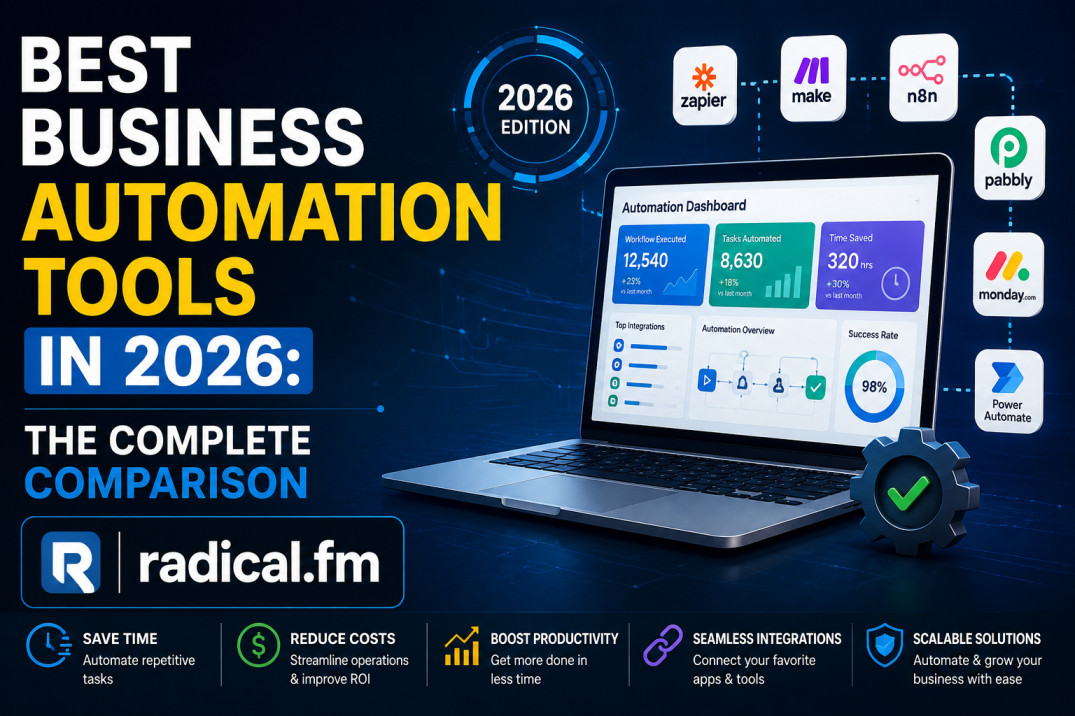
We tested and researched 10 of the fastest-moving automation platforms — from no-code connectors to AI agents and enterprise RPA — so you can pick the right one without paying for features you’ll never touch.
Table of Contents
Quick Picks
Best Overall
Zapier
Widest integration library (7,000+ apps) and the safest default when your team isn’t sure what it needs yet.
Best Value
Make
Roughly 3-5x more automation volume per dollar than Zapier, with a genuinely powerful visual builder.
Best for Developers
n8n
Free, unlimited self-hosting plus real code access when no-code logic hits its ceiling.
Best AI Agent
Lindy AI
Plain-English agent building for inbox, calendar, and outreach work — not a workflow diagram in sight.
Best Free Option
n8n (self-hosted)
Free forever, unlimited executions — you only pay for a $5-7/month VPS to run it on.
Comparison Table
Tool |
Starting Price |
Free Plan |
Best For |
Key Feature |
|---|---|---|---|---|
Zapier |
$19.99/mo (750 tasks) |
100 tasks/mo |
Broadest app coverage |
7,000+ native integrations |
Make |
~$10.59/mo (10,000 ops) |
1,000 ops/mo |
Complex, branching workflows |
Visual scenario builder with routers/loops |
n8n |
Free (self-hosted) / $24/mo cloud |
Unlimited (self-hosted) |
Developers & technical teams |
Open source, JS/Python code nodes |
Lindy AI |
$49.99/mo (Plus) |
7-day trial only |
Solo operators, inbox/calendar |
Natural-language agent builder |
Relay.app |
~$19/mo (Pro) |
Yes (limited runs) |
Approval-gated workflows |
Native human-in-the-loop steps |
Power Automate |
$15/user/mo (Premium) |
Yes, within M365 |
Microsoft 365 shops |
Deep Teams/SharePoint/Outlook ties |
Airtable |
$20/user/mo (Team) |
Yes (1,000 records/base) |
Ops databases + triggers |
Database + automation in one tool |
Pipedream |
$29/mo (Basic) |
100-300 credits/mo |
Code-first API workflows |
Pay for compute time, not per step |
Workato |
~$10,000/yr (est.) |
No |
Enterprise iPaaS/governance |
SOC 2 + ISO 27001, agentic recipes |
UiPath |
$25/mo (Basic) / custom Enterprise |
Trial only |
Enterprise RPA at scale |
Attended + unattended robot fleets |
Detailed Reviews
#1 Zapier
From $19.99/mo
Best for: teams that need to connect a very wide, unpredictable mix of apps without engineering help.
Zapier remains the default answer for a reason: no other platform matches its 7,000+ app catalog, and its interface is the one most non-technical staff can learn in an afternoon. The 2026 pricing model bills by “tasks” (one per completed action), which is straightforward to explain but gets expensive fast once workflows get long — a 5-step Zap running 1,000 times a month burns through the Starter plan’s 750-task allowance in a single day. Zapier’s AI-by-Zapier layer, repriced in mid-2026 around model-based tool calls, adds real agentic capability but is another line item to budget for.
Pros
- Largest integration library in the category, bar none
- Fastest learning curve for non-technical builders
- Mature error-handling and version history tooling
Cons
- Task-based pricing is the most expensive per-execution in this list
- Free plan caps at 100 tasks and 2-step Zaps only
- Complex branching logic is clunkier than Make’s canvas
Key feature: AI by Zapier lets you drop natural-language “AI steps” directly into a Zap to classify, summarize, or route data without a separate LLM integration.
#2 Make
From $9-10.59/mo
Best for: technical marketers and ops teams building multi-branch workflows on a budget.
Make (formerly Integromat) trades some of Zapier’s plain-English simplicity for a visual, flowchart-style canvas that makes branching, error paths, and loops genuinely easier to build and debug. In 2026 Make renamed its billing unit from “operations” to “credits,” but the mechanics are unchanged — every module execution costs one credit, and Core’s 10,000-credit allowance at roughly $9-10.59/month delivers about 13x more raw automation volume than Zapier’s cheapest paid tier. The catch: complex scenarios with loops and iterators burn credits fast, so the sticker price understates real cost for heavy users.
Pros
- 3-5x cheaper than Zapier for equivalent workflow volume
- Visual builder makes complex branching logic actually readable
- 1,500+ prebuilt app modules plus generic HTTP/webhook modules
Cons
- Credit consumption is harder to forecast than Zapier’s flat task count
- Steeper learning curve than Zapier for total beginners
- Overage packs cost 25% more than included credits
Key feature: Native AI Agents (shipped February 2026) run inside the same canvas as regular scenarios, so agentic steps and deterministic automation share one debugging view.
#3 n8n
Free / from $24/mo cloud
Best for: teams with even one technical person who can maintain a small server.
n8n’s open-source Community Edition is genuinely free with unlimited workflows and executions — you only pay for the server it runs on, typically $5-7/month on a bare VPS. That makes it the cheapest serious automation platform in this list by a wide margin, provided someone on the team is comfortable with Docker. For teams that don’t want infrastructure duty, n8n Cloud starts at $24/month for 2,500 executions, billed per completed workflow run rather than per step — a materially different (and often cheaper) model than Zapier’s per-action billing. Its fair-code license restricts reselling n8n itself but places no limits on internal business use.
Pros
- Free self-hosted tier has zero execution limits
- Drop into JavaScript or Python whenever no-code nodes fall short
- 500+ integrations plus a generic HTTP node covers everything else
Cons
- Self-hosting means you own updates, backups, and uptime
- Non-technical staff will need real onboarding time
- Enterprise tier (SSO, log streaming) jumps to roughly €800/month
Key feature: Native LangChain-style AI nodes let you chain LLM calls, vector stores, and memory directly into a workflow — popular for building custom internal AI agents without a separate framework.
#4 Lindy AI
From $49.99/mo
Best for: solo founders and sales/ops teams who want an AI assistant, not a workflow diagram.
Lindy pivoted hard in early 2026 from an agent-builder platform toward a consumer-facing “AI executive assistant” positioning, and dropped its free plan in the process — you now get a 7-day trial and then a $49.99/month floor. What you’re paying for is genuine ease of use: describe a task in plain English (“manage my inbox and draft replies,” “qualify inbound leads and update the CRM”) and Lindy builds the automation, rather than making you assemble it node by node. The trade-off is a credit-metered usage system underneath the flat monthly price — voice calls and browser-automation tasks are especially credit-hungry, and Lindy doesn’t publish exact credit-to-task ratios, so heavy users report unpredictable bills.
Pros
- Build agents by describing them, not wiring diagrams
- Proactive by design — texts context ahead of meetings, flags issues early
- Strong out-of-the-box coverage for inbox, calendar, and lead research
Cons
- No permanent free tier; highest entry price of any tool here
- Native integration count is far smaller than Zapier or Make
- Credit costs for voice and browser tasks are opaque until you’re billed
Key feature: Agents can join Zoom calls to record, transcribe, and summarize automatically, then draft follow-up emails that learn your writing voice over time.
#5 Relay.app
Free – ~$19-29/mo
Best for: ops and compliance teams that need a human to approve AI-driven actions before they go live.
Relay’s whole pitch is that human-in-the-loop approval is a first-class step type, not a bolt-on — you can pause any workflow to require sign-off via email, Slack, or the Relay dashboard before it continues. That’s a meaningfully different design goal from Zapier or Make, which treat approvals as an afterthought bolted onto webhooks. Pricing is run-based (one charge per workflow execution regardless of step count) rather than per-task, which tends to favor longer, more complex workflows. Relay launched a dedicated AI Agents product in February 2026, repositioning itself from “workflow tool” to “AI team builder,” though its integration library (~200 apps) is still a fraction of the size of the incumbents’.
Pros
- Approval gates are native, not a workaround
- Runs billed per execution, not per step — cheaper for multi-step flows
- Genuinely fast to learn; one of the cleanest UIs in the category
Cons
- Integration library is a fraction of Zapier’s or Make’s
- Workflows can stall indefinitely if an approver goes quiet
- Smaller company, sub-$10M funding — worth weighing for long-term reliance
Key feature: Approval requests can be custom-branded and routed through email, Slack, or an in-app inbox, with full audit trails of who approved what and when.
#6 Microsoft Power Automate
$15/user/mo (Premium)
Best for: organizations already standardized on Microsoft 365.
If your company runs on Outlook, SharePoint, Teams, and Excel, a surprising amount of Power Automate is already included free with your M365 license — cloud flows using only standard connectors cost nothing extra. The moment a workflow needs to reach outside the Microsoft ecosystem (Salesforce, SAP, a SQL database), you’re into the $15/user/month Premium tier, which also unlocks attended desktop RPA and AI Builder credits. Unattended, 24/7 robotic process automation is priced separately and per bot ($150/month, or $215/month hosted on Azure), which is where budgets that looked reasonable at the Premium tier can balloon quickly.
Pros
- Effectively free for internal Microsoft-to-Microsoft workflows
- Deepest, most reliable ties to Outlook, Teams, and SharePoint of any tool here
- Single vendor relationship if you’re already an Azure/M365 shop
Cons
- Licensing model (per-user, per-bot, per-flow) is genuinely confusing to budget
- Weak fit for non-Microsoft SaaS stacks compared to Zapier or Make
- Unattended RPA costs scale per bot, not per user — surprises teams fast
Key feature: AI Builder ships with the Premium plan and includes document processing (invoice/receipt extraction) alongside standard automation — no separate OCR tool required.
#7 Airtable
$20/user/mo (Team)
Best for: teams whose automation is really “keep this database in sync and trigger actions off it.”
Airtable isn’t a pure automation platform — it’s a database with automation bolted on — but that combination is exactly what a lot of internal ops teams actually need: a shared source of truth (leads, inventory, content calendar) with triggers that fire when records change. The free plan is genuinely usable for small projects (1,000 records, 100 automation runs/month), but both records and automation runs are hard caps per base, and exceeding either pauses automations until you upgrade or clean house. The jump from Team ($20/user/month) to Business ($45/user/month) is steep and often triggered by compliance needs rather than automation volume.
Pros
- Database and automation live in one tool — no syncing two systems
- Interface Designer lets non-developers build simple internal apps on top
- Generous, genuinely free tier for small teams and side projects
Cons
- Per-base record caps force upgrades that have nothing to do with automation needs
- External client access (Portals) is a costly separate add-on
- Not built for connecting dozens of external SaaS tools — pair it with Zapier/Make for that
Key feature: AI-powered automations (auto-summarize, sentiment analysis, content generation) run natively against your records using a monthly AI-credit allowance included on every paid plan.
#8 Pipedream
Free – $29/mo (Basic)
Best for: developers who want serverless, code-first automation without managing infrastructure.
Pipedream bills for compute time rather than steps or tasks — one credit equals roughly 30 seconds of execution at 256MB of memory — which means a 20-step workflow that finishes in five seconds costs the same as a two-step one that runs just as fast. That’s a genuinely different (and often cheaper) model for API-heavy, code-driven automations than Zapier’s or Make’s per-action billing. The free tier is unusually generous for prototyping, with no credit card required. The one thing to flag clearly: Pipedream was acquired by Workday in 2025, and while self-serve pricing was left intact through mid-2026, the platform’s long-term roadmap for non-Workday customers is genuinely uncertain — worth a conversation with sales before betting critical infrastructure on it.
Pros
- Pay for compute time, not step count — cheap for fast, simple runs
- Full Node.js/Python code steps alongside no-code building blocks
- Free tier is genuinely usable, not just a trial wrapper
Cons
- Workday acquisition creates real uncertainty about long-term direction
- Requires comfort with code — not built for non-technical staff
- Slow upstream API calls can silently burn through a daily credit cap
Key feature: A managed-auth “Connect” API lets developers embed Pipedream’s 10,000+ tool integrations directly inside their own SaaS product for end users, not just internal workflows.
#9 Workato
~$10K-100K+/yr (custom)
Best for: mid-market and enterprise teams that need governed integration across dozens of systems, not a quick Slack-to-Sheets Zap.
Workato plays a different game than everything else on this list: it’s enterprise iPaaS (integration platform as a service), built for organizations that need SOC 2 Type II and ISO 27001 compliance, dedicated customer success, and governance controls around who can touch which “recipe.” Pricing isn’t published — third-party deal data puts SMB-scale contracts around $75,000/year on average and enterprise deployments well past $200,000/year, with entry access sometimes negotiable down to the $10,000/year range for a small footprint. There’s no self-serve signup and no free tier; every deal goes through sales. This is the wrong tool if you just need to connect a form to a spreadsheet.
Pros
- Strongest compliance and governance posture in this list
- 1,200+ enterprise-grade connectors with deep, versioned data mapping
- Dedicated support and implementation team included in enterprise deals
Cons
- No published pricing, no free tier, no self-serve trial
- Six-figure annual contracts are the norm at real scale
- Massive overkill — and budget waste — for SMB or single-department needs
Key feature: Workato One layers agentic orchestration on top of deterministic recipes, letting AI agents make bounded decisions inside governed, audited enterprise processes.
#10 UiPath
$25/mo (Basic) – custom Enterprise
Best for: automating legacy systems and desktop applications that have no usable API.
UiPath is the category leader in robotic process automation (RPA) — software robots that literally click, type, and copy-paste the way a human would, which matters enormously for older enterprise systems (mainframes, legacy Windows apps, some government software) that Zapier and Make simply can’t reach because there’s no API to call. The Basic plan at $25/month is a genuine entry point for testing, but real deployments run through Standard and Enterprise tiers that require a sales conversation, with attended and unattended robot licensing that scales sharply — unattended, 24/7 bots are priced separately from human-assisted “attended” ones, and AI features like Document Understanding and Process Mining layer on additional consumption charges.
Pros
- Only tool here that reliably automates apps with no API at all
- Mature Process Mining and Document Understanding for structured data extraction
- Deepest enterprise RPA track record and partner ecosystem in the category
Cons
- Attended vs. unattended robot licensing is one of the most confusing pricing structures reviewed here
- Real enterprise deployments routinely exceed $400,000/year
- Massive overkill if your systems actually have usable APIs — use Zapier, Make, or n8n instead
Key feature: Screen-scraping computer vision lets robots interact reliably with legacy UIs even when element IDs or layouts change — something API-based tools structurally cannot do.
How to Choose
1. Does anything you need to automate lack an API?
If you’re stuck automating a legacy desktop app, mainframe screen, or anything without a real API, only UiPath (or Power Automate’s desktop RPA) can reliably click through it. Everything else in this list needs an API to talk to.
2. Who’s actually going to build and maintain the workflows?
A non-technical ops team should stay on Zapier, Make, or Airtable. If you have even one engineer who’s comfortable with a server, n8n’s free self-hosted tier is dramatically cheaper for the same volume.
3. Do any workflows need a human to approve an AI-driven action?
If AI agents are drafting emails, updating records, or taking actions with real consequences, Relay.app’s native approval gates are purpose-built for that in a way bolted-on webhooks in Zapier or Make aren’t.
4. Is your stack mostly Microsoft, or mostly everything else?
Power Automate’s M365-included tier is genuinely free for internal Microsoft workflows. Outside that ecosystem, it’s a weaker connector story than Zapier or Make.
5. What does “compliance” actually require of you?
If you need SOC 2, dedicated support, and audited governance across dozens of enterprise systems, that’s Workato’s whole business — and its six-figure pricing reflects it. Don’t pay for that if a $10/month Make plan solves the actual problem.
Rule of thumb
Start with the cheapest tool that can technically do the job — Make or n8n for most teams — and only pay enterprise iPaaS or RPA prices once you can point to a specific compliance requirement or a legacy system with no API. Most companies overbuy the automation category by at least one tier.
2026 Trends Worth Watching
01
Task-based pricing is under pressure
Run-based (Relay, n8n) and compute-based (Pipedream) billing are gaining ground because per-step pricing punishes exactly the complex, multi-step workflows AI makes easier to build.
02
Agentic steps are becoming a checkbox feature
Zapier, Make, and n8n all shipped native AI/agent steps in the past year. The differentiator is shifting from “does it have AI” to “how well does it handle AI making a wrong decision.”
03
Human-in-the-loop is a real category now
Relay’s traction shows demand for approval gates as AI agents get more autonomy. Expect incumbents to bolt on competing approval features rather than build them natively.
04
Self-hosting is back in fashion
n8n’s growth and the rise of cheap VPS hosting have made “own your infrastructure” viable again for teams burned by usage-based pricing spikes on cloud platforms.
05
Big platforms are quietly acquiring automation infra
Workday’s 2025 acquisition of Pipedream is a reminder that developer-first automation tools are becoming acquisition targets — worth factoring into any multi-year platform bet.
06
Database + automation is converging
Airtable’s bet on selling a database with automation attached — rather than automation alone — reflects a broader shift toward “operational systems of record” that trigger their own workflows.
Frequently Asked Questions
What’s genuinely the cheapest way to automate a small business in 2026?
Self-hosted n8n on a $5-7/month VPS is the cheapest option with no meaningful execution limits, but it requires someone comfortable with basic server administration. If you want zero infrastructure responsibility, Make’s free plan (1,000 credits/month) or Zapier’s free plan (100 tasks/month) cover very light usage before you need to pay anything.
Is Make actually cheaper than Zapier, or is that marketing?
It’s real, but the comparison isn’t perfectly apples-to-apples. Make’s Core plan delivers roughly 10,000 credits for about $9-10.59/month against Zapier’s 750 tasks for $19.99/month — a large gap in raw volume per dollar. The catch is that Make counts every module execution as a credit, including loops and iterators, so a workflow with heavy branching can burn credits faster than the headline number suggests.
Do I need coding knowledge to use n8n?
No — n8n’s core nodes work no-code, similar to Zapier or Make. Code becomes optional, not required, and you’d typically only drop into a JavaScript or Python node when a specific transformation isn’t covered by a built-in node. Self-hosting the platform itself is the part that genuinely requires technical comfort, not building the workflows.
What’s the real difference between an automation tool and an AI agent platform like Lindy?
Traditional automation tools (Zapier, Make, n8n) execute deterministic, pre-built logic — if X happens, do Y. AI agent platforms like Lindy are designed to make judgment calls within a task (“draft an appropriate reply,” “decide if this lead is qualified”) rather than following a fixed script. Most teams end up using both: agents for judgment-heavy work, deterministic automation for everything else.
Should a small business ever consider Workato or UiPath?
Almost never at true small-business scale. Both are priced and built for organizations with real compliance requirements, dozens of integrated systems, or legacy software with no API — situations most small businesses simply don’t have. If you’re evaluating either one and your team is under 50 people, it’s worth double-checking whether Make, n8n, or Power Automate actually solves the problem for a fraction of the cost.
Is Pipedream a safe long-term bet after the Workday acquisition?
It’s genuinely unclear as of mid-2026. Self-serve pricing and access were left intact through the acquisition, but Workday’s long-term plans for non-Workday customers haven’t been fully clarified. If you’re building mission-critical infrastructure, it’s worth a direct conversation with Pipedream’s team about roadmap commitments before committing, or keeping a migration path to n8n open as a hedge.
Can Airtable replace Zapier or Make?
Not really — they solve different problems. Airtable’s automations are best for triggering actions off changes to data you store inside Airtable itself. It’s not built to be a general-purpose connector between dozens of external SaaS tools the way Zapier or Make are. Many teams run both: Airtable as the database, Zapier or Make handling the cross-app plumbing.
What’s a realistic monthly budget for a 10-person company’s automation stack?
For a typical mix of CRM syncing, notification workflows, and reporting, expect somewhere between $50-150/month on Make or Zapier at moderate volume, or under $30/month total (server cost) if you’re comfortable self-hosting n8n. Add Lindy’s $49.99+/month if you also want a dedicated AI assistant handling inbox and calendar work — that’s a separate budget line, not a Zapier replacement.
Does Power Automate really cost nothing if I already have Microsoft 365?
For workflows using only standard connectors (Outlook, Teams, SharePoint, OneDrive, Excel, Forms, Planner) between apps you already license, yes — those cloud flows are included at no extra cost. The moment a workflow needs a premium connector (Salesforce, SAP, a SQL database) or unattended desktop automation, you’re into paid licensing on top of your existing M365 subscription.
How often do these prices actually change?
More often than most buyers expect. Several vendors in this list — Make, n8n, Lindy, Zapier’s AI tools — restructured pricing or renamed their billing units at least once in the past year. Always confirm current numbers on the vendor’s own pricing page before signing an annual contract; the figures in this article were verified against vendor pages and third-party pricing trackers in August 2026.
Final Recommendations
Solo founder / freelancer
Make + Lindy AI
Make’s Core plan handles cross-app plumbing cheaply; Lindy handles the judgment-heavy inbox and calendar work you’d otherwise do yourself.
10-50 person startup
Zapier or Make + Airtable
A general-purpose connector plus a shared operational database covers most internal workflows without a dedicated engineer.
Technical / engineering team
n8n (self-hosted)
Free, unlimited executions, and full code access when workflows outgrow what any no-code tool can express cleanly.
Microsoft-standardized enterprise
Power Automate
Included coverage for internal M365 workflows, with Premium and RPA tiers available as needs grow past the free tier.
Compliance-heavy financial/healthcare org
Workato + Relay.app
Workato’s governance and audit trails for core system integration, Relay’s approval gates for anywhere AI touches customer-facing actions.
Legacy-system-heavy enterprise
UiPath + Power Automate
UiPath’s RPA reaches systems with no API at all; Power Automate covers the modern, API-based Microsoft workflows around them.
Pricing and features verified against vendor pricing pages and third-party pricing trackers as of August 2026. Automation pricing changes frequently — confirm current figures directly with each vendor before purchasing.