
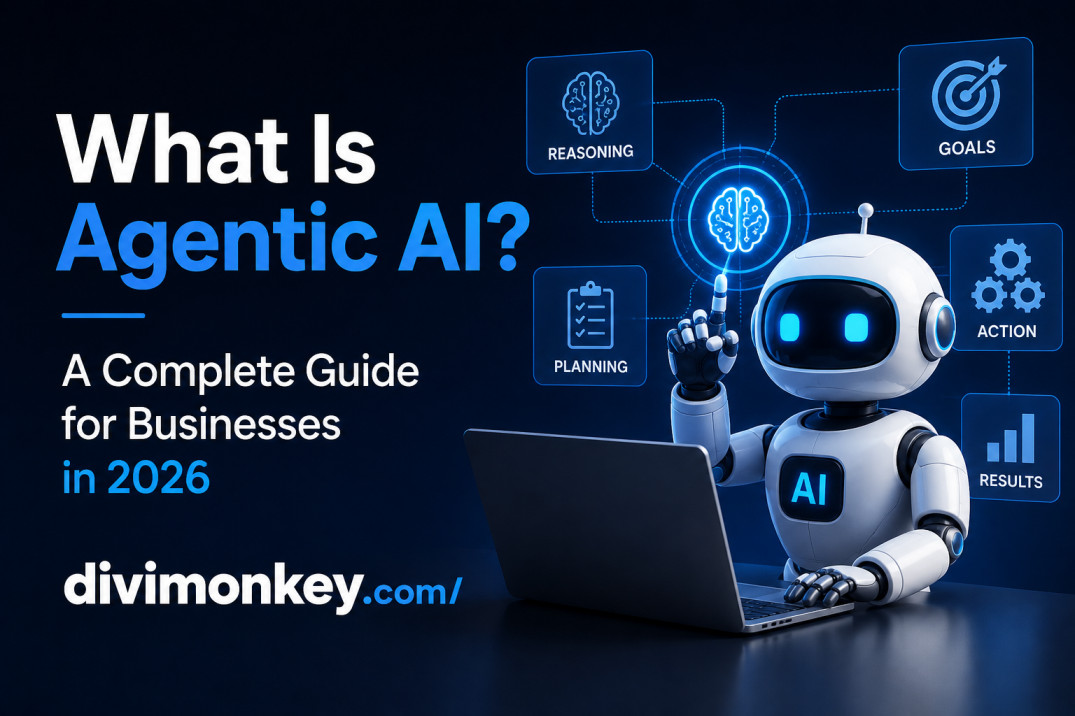
Most business software still waits for you. You click, it responds. You ask, it answers. Agentic AI flips that relationship: instead of waiting for instructions at every step, it plans a sequence of actions, carries them out, checks its own results, and adjusts course when something doesn’t go as expected.
That shift — from tool to teammate — is why so many companies are re-evaluating how they use AI in 2026. This guide explains what agentic AI actually is, how it differs from the chatbots and automations you already know, where it delivers real value, and what to consider before deploying it in your business.
What Is Agentic AI, Exactly?
Agentic AI refers to AI systems built to pursue a goal with a degree of independence — determining the steps needed, using tools or software to complete them, evaluating the outcome, and revising the plan if the first approach fails.
The defining trait isn’t intelligence in the abstract sense. It’s autonomy over a multi-step process. Give a traditional AI model a single prompt and it gives you a single response. Give an agentic AI system an objective — “reconcile this month’s invoices and flag discrepancies” — and it will break that down into sub-tasks, execute them using the tools it has access to (spreadsheets, databases, email, APIs), and report back, often without a human approving each individual step.
The Core Components
Most agentic AI systems share a few structural elements:
- A reasoning engine – typically a large language model (LLM) that interprets the goal and plans steps
- Tool access – the ability to call APIs, query databases, browse the web, run code, or operate software
- Memory – short-term context about the current task, and sometimes longer-term memory across sessions
- A feedback loop – a way to check whether an action succeeded and decide what to do next
This loop — plan, act, observe, adjust — is what separates agentic systems from single-shot AI tools.
Agentic AI vs. Traditional AI vs. Generative AI
These terms get used interchangeably, but they describe different things.
Type |
What it does |
Example |
|---|---|---|
Traditional/Predictive AI |
Analyzes data and predicts an outcome |
Fraud-detection scoring, demand forecasting |
Generative AI |
Produces new content in response to a prompt |
Drafting an email, generating an image |
Agentic AI |
Plans and executes a multi-step task toward a goal, with minimal supervision |
Researching vendors, comparing quotes, and drafting a purchase recommendation unprompted at each step |
A useful way to think about it: generative AI answers a question. Agentic AI completes a job. Many agentic systems use generative AI (an LLM) as their reasoning core, but they wrap it with planning logic, tool access, and self-correction that a standalone chatbot doesn’t have.
How Agentic AI Actually Works
A typical agentic workflow follows a repeating cycle:
- Goal interpretation — The system receives an objective, often in plain language, and breaks it into smaller tasks.
- Planning — It decides the order of operations and which tools or data sources are needed for each.
- Execution — It acts: calling an API, filling a form, querying a database, sending a message.
- Observation — It checks the result of that action against what it expected.
- Adjustment — If something failed or the output looks wrong, it revises the plan and tries again, or escalates to a human.
This is different from robotic process automation (RPA), which follows a fixed, pre-programmed sequence of steps and breaks when anything unexpected happens. Agentic AI is designed to handle the unexpected within reason — a missing field, an error message, an ambiguous result — by reasoning about it rather than halting.
Why Businesses Are Paying Attention Now
A few practical developments have made agentic AI viable at scale:
- Better reasoning models. Newer LLMs are more reliable at multi-step planning and less prone to losing track of a task partway through.
- Tool-calling standards. Frameworks that let AI models interact with external software (databases, SaaS tools, internal systems) in a structured, safer way have matured.
- Falling inference costs. Running an AI system through many steps of reasoning used to be expensive; it’s now practical for everyday business tasks.
- Enterprise pressure to cut manual work. Many of the tasks agentic AI targets — data entry, research, first-draft reporting, customer triage — are high-volume and low-differentiation, making them attractive automation targets.
Practical Business Use Cases
Agentic AI tends to work best on tasks that are repetitive, rule-influenced, but not perfectly predictable — the middle ground between “too simple to need AI” and “too judgment-heavy to automate.”
Customer support
An agent can look up an order, check a return policy, process a refund, and email the customer confirmation — end to end — escalating to a human only for edge cases.
Sales and research
Agents can research a list of prospects, pull relevant company data, draft personalized outreach, and log everything to a CRM, rather than a rep doing each step manually.
Finance and operations
Reconciling invoices, matching purchase orders to receipts, and flagging anomalies are well-suited to agentic workflows because the steps are structured but the exceptions vary.
IT and software
Agents can monitor systems, diagnose the likely cause of an error, attempt a fix, and only page an engineer if the fix fails — reducing time spent on routine incidents.
HR and recruiting
Screening resumes against a role’s requirements, scheduling interviews across calendars, and following up with candidates can be handled with far less manual coordination.
Risks and Limitations to Understand Before Deploying
Agentic AI’s independence is also where the risk lives. Businesses evaluating it should weigh:
- Error compounding. A mistake in step two can cascade through every later step before anyone notices, especially in fully unsupervised workflows.
- Tool and data access risk. Giving an AI system access to email, financial systems, or customer data expands your attack surface and requires the same access controls you’d apply to a human employee.
- Accountability gaps. If an agent makes a decision that affects a customer or a financial record, someone needs to own that outcome — clear escalation paths and audit logs matter.
- Cost unpredictability. Multi-step reasoning tasks can consume significantly more compute (and cost) than a single AI response, especially if an agent gets stuck retrying.
- Overconfidence in outputs. Agentic systems can complete a task “successfully” while still producing an incorrect or nonsensical result — the process running smoothly doesn’t guarantee the outcome is right.
How to Evaluate Agentic AI for Your Business
Before adopting an agentic AI tool or building a custom agent, it helps to ask a few grounding questions:
- Is the task well-defined but variable? Agentic AI shines when steps are fairly consistent but inputs differ each time — not when every case is truly unique, and not when a simple script would already do the job.
- What’s the cost of a mistake? Low-stakes tasks (drafting an email) tolerate more autonomy than high-stakes ones (approving a payment).
- Do you have a human-in-the-loop option? The safest early deployments keep a person reviewing outputs before anything irreversible happens, then gradually expand autonomy as trust builds.
- Can you audit what the agent did? Look for tools that log every action and decision, not just the final result — this matters for debugging and for compliance.
- What systems does it need access to? Map out exactly which tools, data, and permissions an agent requires, and apply the principle of least privilege.
Getting Started: A Practical Path
- Pick one narrow, repetitive workflow rather than trying to automate an entire department at once.
- Run it with human review for a defined period before removing oversight.
- Track failure modes, not just success rates — understanding how an agent fails tells you where to add guardrails.
- Expand gradually to adjacent tasks once the first workflow is stable.
The Bottom Line
Agentic AI isn’t a single product — it’s a design pattern: AI systems that plan, act, and self-correct toward a goal rather than simply responding to a prompt. That makes it genuinely useful for structured, repetitive business processes that currently eat up staff time, from customer support to finance operations to research.
The technology is real and improving quickly, but the businesses getting the most value from it aren’t the ones handing over the most control the fastest. They’re the ones starting with a well-scoped task, keeping a human in the loop while they learn where the system is reliable, and expanding autonomy deliberately from there.