
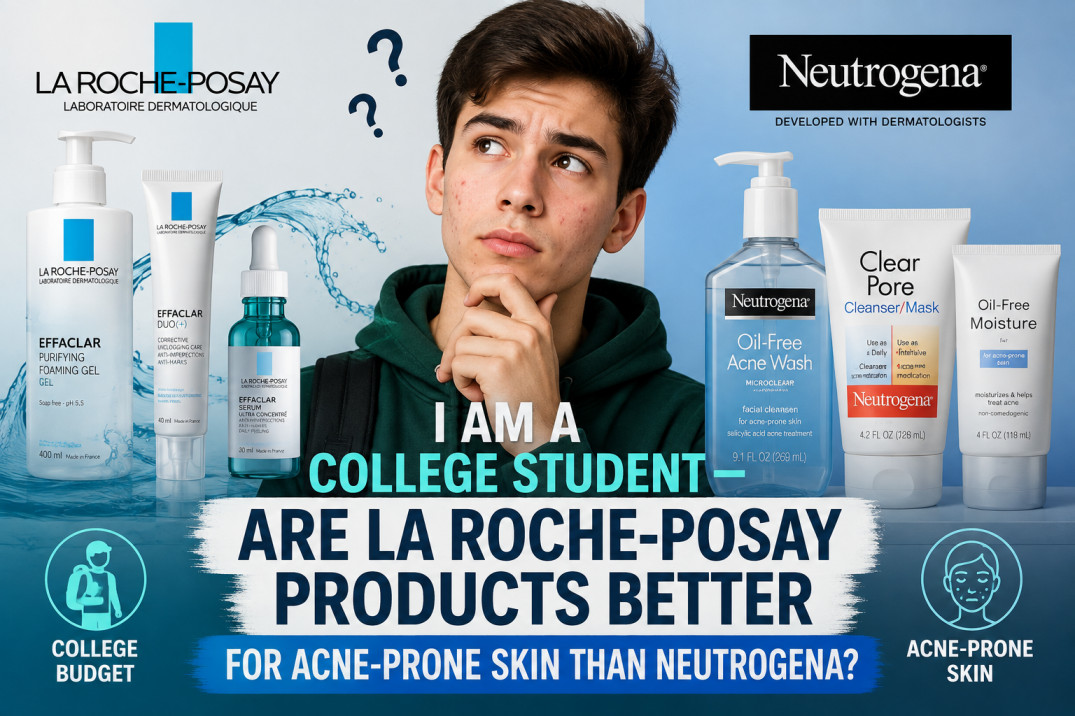
A budget-minded, ingredient-first breakdown for any college student trying to decide between La Roche-Posay and Neutrogena for acne-prone skin — without wasting a semester’s laundry money.
Dermatology-guided
Student budget friendly
Quick Answer
No — La Roche-Posay is not automatically better than Neutrogena for acne-prone skin. Both brands sell the same proven actives (salicylic acid, benzoyl peroxide, adapalene), sometimes at identical strengths. As a college student, the smarter question isn’t “which brand,” it’s “which exact formula fits my acne, my skin, and my budget.”
On This Page
“I am a college student. Are La Roche-Posay products better for acne-prone skin than Neutrogena?” It’s one of the most common questions in dorm-room skincare, and here’s the honest answer: La Roche-Posay is not inherently better for acne-prone skin than Neutrogena. Both brands rely on the same short list of dermatologist-backed actives — salicylic acid, benzoyl peroxide, and adapalene — and in several head-to-head cases, the concentration is exactly the same.
The real decision isn’t about brand prestige. It’s about which specific formula matches your acne type, how reactive your skin is, and whether you can actually afford to keep using it after the first tube runs out.
La Roche-Posay vs Neutrogena: At a Glance
The Active Ingredient Matters More Than the Brand
Dermatology guidance strongly supports topical retinoids and benzoyl peroxide for acne, with salicylic acid recommended for the right candidates — and none of that guidance cares whether the label says La Roche-Posay or Neutrogena. A premium product can still irritate your skin, while a $9 formula can work beautifully when it has the right active and you use it consistently.
Salicylic Acid — For Clogged Pores
La Roche-Posay’s Effaclar Medicated Acne Face Wash and Neutrogena’s Oil-Free Acne Wash Fragrance Free both currently list 2% salicylic acid in their US formulas — identical strength. La Roche-Posay adds glycerin and lipo-hydroxy acid but also includes menthol, which can sting reactive skin. Neutrogena’s fragrance-free version is the simpler option if you just want the active without the extras.
Benzoyl Peroxide — For Inflamed Pimples
Neutrogena’s Stubborn Acne line offers a 2.5% leave-on treatment; La Roche-Posay’s Effaclar range includes a 4% wash. These aren’t directly comparable by percentage alone — a leave-on sits on skin far longer than a rinse-off cleanser. Never stack both at once just because they’re different brands.
Heads up: Benzoyl peroxide can bleach towels and pillowcases. Buy from a reputable seller, store it properly, and check the expiration date before use.
Adapalene — For Acne That Keeps Returning
Both brands sell 0.1% adapalene gel in the US — same strength, nearly identical gel base. Paying more here does not buy a stronger treatment.
Does La Roche-Posay Actually Formulate Better?
La Roche-Posay’s sensitive-skin reputation comes largely from its Toleriane line — it doesn’t automatically carry over to every Effaclar acne product. The Effaclar Duo+M pairs 0.5% salicylic acid with niacinamide but also lists fragrance; the Medicated Acne Face Wash skips fragrance but contains menthol. Neutrogena is just as mixed: the classic Oil-Free Acne Wash lists fragrance, while a separate fragrance-free version and the Evenly Clear line (fragrance-free, dye-free, non-comedogenic) exist too.
Bottom line: neither brand is uniformly gentle. Check the exact product label, not the brand’s overall image.
Which Brand Wins for Sensitive, Acne-Prone Skin?
If your skin reacts easily, skip the medicated cleanser altogether. Start with a gentle, fragrance-free wash and one carefully chosen leave-on treatment so you can isolate what’s actually causing irritation.
Signs your routine is too aggressive:
- Persistent burning or stinging
- Increasing redness
- Tight, shiny, or cracked skin
- Heavy peeling
- New breakouts alongside widespread irritation
Which Brand Gives a College Student Better Value?
For most students, Neutrogena is the more practical starting point — widely available, frequently discounted, and stocked with evidence-based actives at accessible prices. La Roche-Posay earns its higher price only when a Neutrogena formula keeps irritating your skin, a specific texture is genuinely easier to use daily, or you need a particular fragrance-free product.
Consistency > Prestige
A $10 product used correctly for 8 weeks beats a $40 routine abandoned after 10 days.
Mix & Match Is Fine
A Neutrogena treatment with a La Roche-Posay moisturizer (or the reverse) works, as long as the full routine suits your skin.
Three Simple Routines for College Students
Pick the one that matches your acne — don’t start all three at once.
Blackheads & Whiteheads
AM: Gentle/2% salicylic cleanser → moisturizer → SPF 30+
PM: Gentle cleanser → moisturizer
Red, Inflamed Pimples
AM: Gentle cleanser → low-strength benzoyl peroxide → moisturizer → SPF 30+
PM: Gentle cleanser → moisturizer
Recurring Mixed Acne
AM: Gentle cleanser → moisturizer → SPF 30+
PM: Gentle cleanser → 0.1% adapalene → moisturizer
How Long Before You See Results?
Don’t judge a product after three days. Most people see some improvement around 4–6 weeks, with clearer skin taking 2–3 months or longer. Take photos in similar lighting every two weeks — it’s more reliable than checking the mirror all day.
See a dermatologist for deep or painful nodules, cystic acne, scarring, rapid worsening, or acne that hasn’t responded to consistent over-the-counter care.
The Bottom Line
La Roche-Posay isn’t universally better than Neutrogena for acne-prone skin. For most college students, Neutrogena offers the stronger value, since it often delivers the same active ingredient at the same strength for less money. Choose La Roche-Posay when a specific formula genuinely suits your skin better — not because of the price tag.
Frequently Asked Questions
Is La Roche-Posay better than Neutrogena for hormonal acne?
Not automatically. Persistent jawline acne or breakouts tied to hormonal changes often need a dermatologist’s input rather than an over-the-counter fix from either brand.
Is Neutrogena too harsh for acne-prone skin?
Some formulas can be drying, but others are fragrance-free and built for sensitive skin. Judge each product by its own label, not the brand as a whole.
Is La Roche-Posay worth the extra money?
Only if it helps you stay consistent because it’s more comfortable. If a cheaper product has the same active at the same strength and your skin tolerates it, the extra cost buys little.
Can I mix La Roche-Posay and Neutrogena products?
Yes. Just avoid doubling up on strong actives — combining a salicylic cleanser, toner, benzoyl peroxide, and adapalene at once will irritate your skin regardless of brand.
Should I start with salicylic acid or adapalene?
Salicylic acid is a gentler entry point for mild blackheads and whiteheads. Adapalene works better for recurring, mixed acne but needs more patience with dryness.