
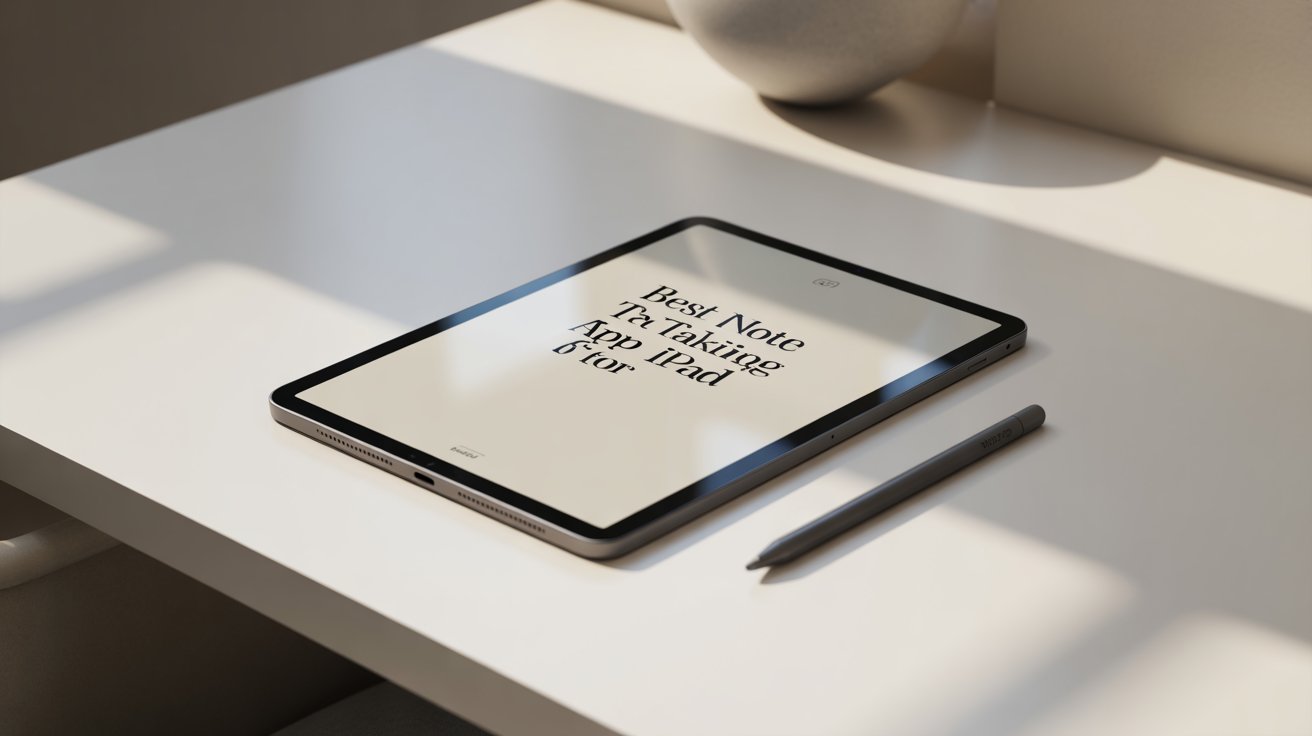
The iPad has evolved into a serious productivity tool especially with the Apple Pencil becoming more precise, iPadOS adding better multitasking, and apps adopting AI-assisted handwriting recognition. But the built-in Apple Notes app still isn’t enough for students, professionals, or creators who need deeper organization, structured documents, handwritten math support, or multimedia notes.
In 2025, note-taking apps fall into three major categories:
(1) handwriting-first apps, (2) typing/organization-focused apps, and (3) hybrid apps that combine everything.
Below is a modern, insight-rich breakdown of the best iPad note-taking apps and more importantly, who each one is actually best for.
1. GoodNotes 6 — Best Overall for Handwriting
GoodNotes continues to lead the handwriting category because it feels closest to writing on real paper but with the power of digital search, folders, templates, and cloud sync.
Why GoodNotes Stands Out in 2025
-
Its handwriting engine has become almost textbook-clean with better shape detection and smoother strokes.
-
Great for math, chemistry, architecture, and other technical subjects because diagrams feel natural.
-
Notebooks feel structured and visually organized ideal for students or anyone who thinks in “pages.”
Pros
-
Best-in-class handwriting feel
-
Handwriting-to-text that rarely makes mistakes
-
Great template system (journals, planners, dotted pages, engineering paper)
-
Easy PDF annotation
Cons
-
Starts to feel heavy if you only want basic notes
-
Subscription required for unlimited notebooks
Best for: Students, visual learners, technical note-takers.
2. Notability — Best for Lectures and Meetings
Notability is the only major app that truly synchronizes audio recordings with your handwritten notes. Tap a word you wrote, and it jumps to the exact moment in the audio a game-changer for lectures and meetings.
Why Notability Is Valuable in 2025
-
New AI cleanup features make messy handwriting look clean instantly.
-
Audio-sync makes it almost impossible to miss important details.
-
Flexible: supports handwriting, typing, highlights, images, and stickers.
Pros
-
Perfect for lecture-heavy learning
-
Audio + handwriting sync
-
Fast switching between pen, highlighter, and eraser
Cons
-
Full features require subscription
-
Organization tools not as clean as GoodNotes
Best for: Students, journalists, meeting-heavy professionals.
3. Nebo — Best for Converting Handwriting Into Structured Documents
Nebo is the only app that doesn’t just recognize handwriting, it actually turns it into editable text, formulas, diagrams, and flowcharts. It feels like a blend of a notebook and a word processor.
Why Nebo Is Different
-
You can handwrite a messy equation and Nebo turns it into a clean math expression.
-
Great for engineering, science, and business diagrams.
-
AI-powered layout helps convert sketches into structured diagrams.
Pros
-
Exceptional handwriting-to-text
-
Converts math, diagrams, arrows, and shapes
-
Export to Word, PDF, or HTML
Cons
-
Best performance requires Apple Pencil
-
Interface feels more “technical” than artistic
Best for: Engineers, scientists, researchers, business users.
4. Evernote — Best Cross-Platform Note System
Evernote remains a giant for people who want their notes everywhere iPad, Windows laptop, Android phone, web browser all synced.
Why Evernote Still Matters in 2025
-
Great for collecting mixed content: images, web clippings, typed notes, attachments.
-
Highly searchable, even inside documents and images.
-
Ideal for long-term knowledge management.
Pros
-
Excellent organization with tags + notebooks
-
Works flawlessly across devices
-
Perfect for research and document-heavy workflows
Cons
-
Free plan is very limited
-
Heavier than handwriting-first apps
Best for: Professionals, researchers, cross-device users.
5. OneNote — Best for Students in the Microsoft Ecosystem
OneNote feels endless like an infinite canvas for your ideas. If you use Windows or Microsoft Office, this is the most seamless choice.
Why OneNote Works Well
-
Sections + pages mimic physical binders.
-
Good for collaboration and shared notebooks.
-
Works with stylus or keyboard equally well.
Pros
-
Completely free
-
Mixes handwriting, typing, images, audio
-
Excellent for school or work teams
Cons
-
Interface can feel cluttered
-
Handwriting feels less natural than GoodNotes
Best for: Students, office workers, Surface + iPad dual users.
6. Bear — Best for Writers and Thinkers
Bear is minimalist, elegant, and designed for pure thinking. It uses Markdown, which makes it perfect for writers, creators, and people who need a clean, distraction-free space.
Why Bear Is Loved by Writers
-
Tags create an incredibly flexible, nested organization system.
-
Sync is fast, notes are lightweight, and the design is gorgeous.
-
Great for journals, blog drafts, planning, and idea capture.
Pros
-
Clean and fast
-
Great for long-form writing
-
Strong search and tagging
Cons
-
Not good for handwriting or heavy media
-
Requires subscription for sync
Best for: Writers, bloggers, planners, minimalist note-takers.
7. Simplenote — Best Free Minimal Note App
Simplenote is exactly what the name says simple. Fast, text-only notes that sync everywhere.
Why Simplenote Still Works
-
Zero clutter, zero learning curve.
-
Works well even with thousands of notes.
-
Great for ideas, lists, drafts, reminders.
Pros
-
Free
-
Very fast
-
Great for plain text
Cons
-
No images, drawings, or PDFs
-
Too basic for heavy academic notes
Best for: Minimalists, productivity lovers, quick capture.
8. Noteshelf — Best Balance of Handwriting + Flexibility
Noteshelf is a “middle ground” app: more artistic than GoodNotes, but more structured than Squid. It supports handwriting, typing, audio, shapes, and PDF annotation.
Why Noteshelf Is Underrated
-
Natural pen strokes that feel similar to GoodNotes.
-
Better color and brush variety than many apps.
-
Great for creatives who also want structured notebooks.
Pros
-
Excellent handwriting feel
-
Lots of brush/pen styles
-
Strong PDF tools
Cons
-
Not as powerful in text conversion as Nebo
-
One-time purchase required
Best for: Students, designers, creators.
9. Squid — Best for “Digital Whiteboard” Note-Taking
Squid feels like writing on a big sheet of paper. The infinite canvas makes it perfect for brainstorming and sketching.
What Makes Squid Useful
-
Ideal for diagrams, brainstorming sessions, or visual planning.
-
Pressure-sensitive strokes feel natural.
-
Notes resize without pixelation because they’re vector-based.
Pros
-
Infinite canvas
-
Great for sketch-heavy notes
-
Natural handwriting
Cons
-
Not ideal for typing
-
Organization tools are basic
Best for: Creatives, designers, whiteboard thinkers.
10. Zoho Notebook — Best Visual Note App
Zoho Notebook uses “card-style” notes: text cards, image cards, audio cards, checklist cards, very visually organized.
Why Visual Thinkers Love It
-
Each type of note looks different, making it easy to scan.
-
Great for keeping personal notes, ideas, and projects organized.
-
Attractive design without complexity.
Pros
-
Free
-
Visually appealing
-
Supports mixed content
Cons
-
Not suitable for advanced handwriting users
-
Limited export formats
Best for: Creatives, planners, mixed-media note-takers.
Which App Should You Choose? (2025 Decision Guide)
Best for Handwriting:
✔ GoodNotes
✔ Noteshelf
✔ Nebo
Best for Students:
✔ Notability
✔ OneNote
✔ Nebo
Best for Work/Business:
✔ Evernote
✔ OneNote
✔ Nebo
Best for Writers:
✔ Bear
✔ Simplenote
Best for Visual Thinkers:
✔ Noteshelf
✔ Zoho Notebook
✔ Squid
iPad Note-Taking Trends in 2025
1. AI-assisted note cleanup and conversion
Apps are increasingly offering automatic formatting, handwriting cleanup, and summarization.
2. Blended handwriting + typing workflows
People expect to sketch diagrams, type meeting summaries, and embed images in one note.
3. Cross-device sync matters more than ever
Students and professionals switch between iPad, laptop, and phone constantly.
4. PDF annotation is now a standard requirement
Especially for school assignments, business documents, and research papers.
Final Thoughts
The “best” note-taking app in 2025 depends entirely on your workflow. If you’re primarily a handwriting user, start with GoodNotes, Nebo, or Notability. If you type a lot or need research-style organization, choose Evernote, OneNote, Bear, or Simplenote.