

Beginner Skincare Guide · Updated 2026
A clear, evidence-based comparison to help first-timers pick between two of the world’s most popular drugstore skincare brands — based on skin type, ingredients, and real routine-building, not hype.
Quick Answer
Yes — Nivea is generally the gentler, more beginner-safe starting brand because it’s built almost entirely around simple hydration with few active ingredients. Garnier is also beginner-friendly, but leans toward targeted actives (vitamin C, salicylic acid, niacinamide), which makes it the stronger pick if you have oily, dull, or acne-prone skin and want faster visible results. Neither brand is “better” in general — the right one depends on your skin type.
Standing in the skincare aisle for the first time is genuinely overwhelming. Shelves of cleansers, serums, and moisturizers all claim to be exactly what your skin needs, and two names almost always show up first: Nivea and Garnier. Both are affordable, sold in nearly every supermarket and pharmacy, and marketed specifically toward people who aren’t skincare experts. That’s exactly why they’re worth comparing properly before you buy anything.
This guide breaks down what each brand actually is, how their product philosophies differ, which one suits which skin type, and how to build a simple, effective first routine — without wasting money on products your skin doesn’t need yet.
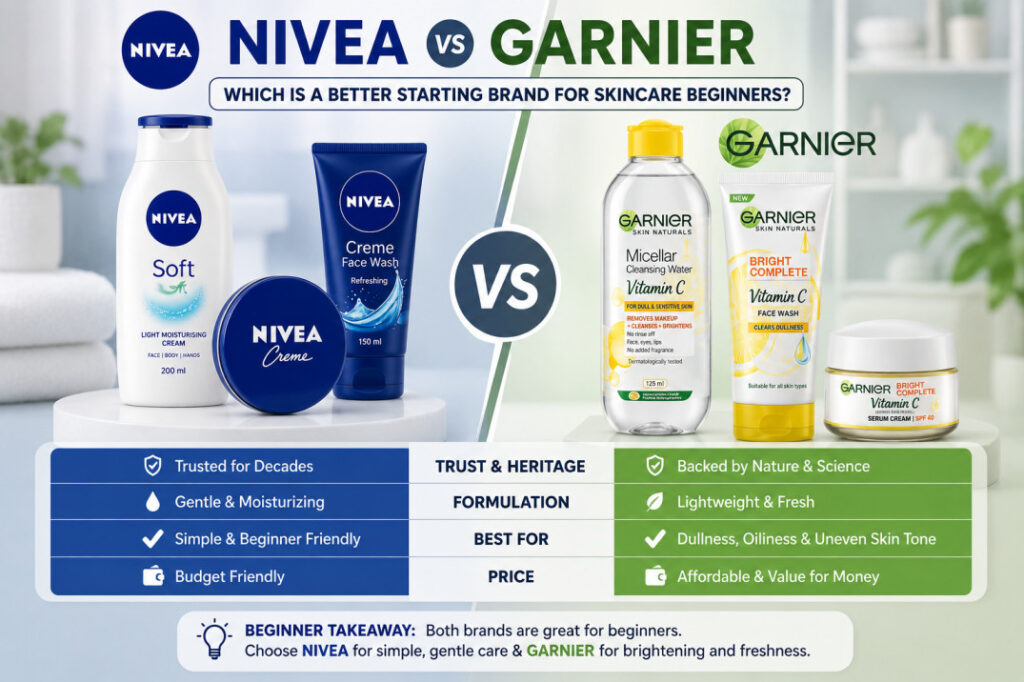
Nivea vs Garnier: At a Glance
Table of Contents
ToggleCategory |
Nivea |
Garnier |
|---|---|---|
Origin |
German brand (Beiersdorf), founded 1911 |
French brand, part of the L’Oréal Group |
Core focus |
Hydration and skin-barrier comfort |
Targeted actives — brightening, oil control, exfoliation |
Best skin type |
Dry, normal, sensitive, mature |
Oily, combination, dull, acne-prone |
Typical formulas |
Simple, low-active, cream-based |
Vitamin C, niacinamide, salicylic acid, PHA/glycolic acid |
Signature product |
The blue-tin Nivea Creme |
SkinActive Micellar Water |
Price range |
$4–$14 per item |
$5–$15 per item |
Learning curve |
Very low — hard to get wrong |
Low-to-moderate — actives need slow introduction |
Understanding Nivea’s Approach to Skincare
Nivea has been making the same promise since 1911: keep skin comfortable and hydrated without overcomplicating things. It’s owned by the German company Beiersdorf, and its identity is still anchored by the iconic blue tin moisturizer that most households have owned at some point. Over the decades, the range expanded into cleansers, sun protection, night creams, and body care, but the philosophy hasn’t really changed — formulas are built to feel soothing on skin rather than to deliver a strong active-ingredient punch.
For a beginner, that’s the entire appeal. There’s very little risk of irritation because most Nivea products aren’t designed to “do” much beyond moisturizing, cleansing gently, and protecting from sun. You don’t need to research percentages or worry about layering incompatible ingredients — you can pick a cleanser and a moisturizer and use them daily with almost no learning curve.
Where Nivea can fall short: some of its richer cream formulas use ingredients that are commonly flagged as comedogenic (pore-clogging) on ingredient-checking databases, so beginners with oily or acne-prone skin sometimes find Nivea’s heavier creams feel too heavy or contribute to breakouts. It’s rarely a problem for dry or normal skin, but it’s worth knowing before you buy.
Understanding Garnier’s Approach to Skincare
Garnier is a French brand under the L’Oréal Group, and its skincare identity centers on the SkinActive line — cleansers, micellar waters, and serums built around active ingredients like vitamin C, niacinamide, and salicylic acid. Instead of positioning itself purely as a moisturizing brand, Garnier markets products that solve specific concerns: dullness, uneven tone, excess oil, and clogged pores.
The brand’s biggest beginner-friendly product is its Micellar Cleansing Water, which uses micelle technology to lift away makeup, oil, and dirt without rinsing or rubbing. Several versions (including the Vitamin C and Hyaluronic Acid formulas) are listed by Garnier as fragrance-free, oil-free, and alcohol-free, which is genuinely useful information for a beginner nervous about irritation — it’s one of the few claims in this comparison that’s independently verifiable on the brand’s own product pages.
Where Garnier needs more care: its treatment products — vitamin C serums, salicylic acid cleansers, and PHA/glycolic exfoliating waters — are active by design. That’s a strength for people who want visible results, but active ingredients are exactly the category beginners should introduce slowly, a few times a week, rather than in a full daily routine from day one.
Nivea vs Garnier by Skin Type
Skin Type |
Better Starting Brand |
Why |
|---|---|---|
Dry / Very Dry |
Nivea |
Rich, occlusive creams built specifically for moisture retention |
Oily |
Garnier |
Lightweight, mattifying, and oil-control formulas won’t feel greasy |
Combination |
Either / mix |
Nivea moisturizer on dry patches, Garnier cleanser for the oily zone works well |
Sensitive |
Nivea (usually) |
Fewer actives means lower irritation risk overall |
Acne-prone |
Garnier |
Salicylic acid and non-heavy formulas suit clog-prone skin better |
Dull / Uneven tone |
Garnier |
Vitamin C line is specifically formulated to brighten |
Comparing Key Product Categories
Cleansers
Garnier’s Micellar Water is arguably the strongest single product in this comparison for beginners — it removes makeup, dirt, and excess oil in one no-rinse step, which makes it forgiving even if you skip a “proper” double cleanse. Nivea’s cleansers are more traditional face washes: gentle, effective, but they don’t multitask the way micellar water does.
Moisturizers
This is Nivea’s strongest category by a wide margin. The Nivea Creme and Nivea Soft (with jojoba oil) are formulated purely to lock in moisture, and they do it reliably across dry, normal, and mature skin. Garnier’s moisturizers exist but are a smaller, less central part of its lineup compared to its cleansers and serums.
Actives & Serums
Garnier clearly wins here. Its vitamin C, niacinamide, and exfoliating-acid products give beginners an accessible entry point into “real” active skincare without luxury pricing. Nivea’s lineup includes some targeted night creams and serums, but active ingredients aren’t the brand’s central strength.
Sunscreen
Both brands offer daily SPF options at drugstore prices, and either is a reasonable choice for building the sunscreen habit — which matters more at the beginner stage than which brand’s SPF you pick.
Pros & Cons of Nivea for Beginners
Pros
- Very low irritation risk
- Excellent for dry and sensitive skin
- Small, easy-to-understand product range
- Widely available and affordable
Cons
- Some creams may feel heavy on oily skin
- A few formulas are considered comedogenic-leaning
- Limited active-ingredient options for targeted concerns
Pros & Cons of Garnier for Beginners
Pros
- Micellar Water is genuinely versatile and beginner-proof
- Good fit for oily, dull, and acne-prone skin
- Affordable access to real active ingredients
- Several formulas are fragrance-free and alcohol-free
Cons
- Actives can irritate skin if introduced too quickly
- Larger range can feel confusing for a first-timer
- Moisturizer line is less specialized than Nivea’s
Building Your First Skincare Routine
Regardless of which brand you choose, the biggest beginner mistake isn’t picking the “wrong” brand — it’s trying to do too much too soon. A basic three-step routine, done consistently, outperforms a complicated ten-step one that gets abandoned after two weeks.
Starter routine for dry or normal skin (Nivea-led)
1. Gentle cleanser, morning and night
2. Nivea Creme or Nivea Soft moisturizer
3. Daily SPF in the morning
Starter routine for oily or dull skin (Garnier-led)
1. Garnier Micellar Water, morning and night
2. Lightweight moisturizer
3. Daily SPF, then introduce a vitamin C or niacinamide product 2–3 times a week once skin adjusts
Give any new routine at least four to six weeks before judging it. Skin needs time to adjust, and switching products too early is one of the most common reasons beginners feel like “nothing works.”
Common Mistakes Skincare Beginners Make
- Introducing multiple active ingredients (vitamin C, salicylic acid, retinol) at the same time
- Skipping sunscreen, which undoes progress from other products
- Judging a product after only a few days instead of several weeks
- Choosing products based on trends rather than actual skin type or concern
- Using rich moisturizers on oily, acne-prone skin, which can worsen congestion
Can You Mix Nivea and Garnier?
Yes, and many people do. Brand loyalty isn’t a skincare requirement — what matters is whether each individual product suits your skin. A common combination is a Garnier cleanser (like the Micellar Water) paired with a Nivea moisturizer, giving you Garnier’s effective cleansing and Nivea’s proven hydration in one simple routine. There’s no formulation conflict between the two brands; they’re not designed as an exclusive “system.”
The Verdict
Neither brand is universally better — the right starting point depends entirely on your skin. If you’re new to skincare with dry, sensitive, or normal skin, Nivea’s simplicity makes it the safer, lower-risk choice. If you have oily, dull, or acne-prone skin and want to start incorporating active ingredients from the beginning, Garnier gives you more targeted tools without pushing you into an expensive routine. Many beginners end up using both, and that’s a perfectly reasonable long-term approach.
Frequently Asked Questions
Is Nivea good for beginners with acne-prone skin?
Not always the best first choice. Some of Nivea’s richer creams are considered comedogenic-leaning, which can worsen breakouts for acne-prone skin. A lighter Garnier moisturizer or cleanser is usually a better starting point for this skin type.
Does Garnier’s micellar water need to be rinsed off?
No, it’s designed as a no-rinse cleanser — you saturate a cotton pad and wipe it over the skin. Many beginners still follow up with plain water or a gentle face wash if wearing heavy makeup or SPF.
Can I use vitamin C and Nivea moisturizer together?
Yes. A common beginner routine applies a vitamin C serum first, lets it absorb, then follows with a Nivea moisturizer to lock in hydration. There’s no ingredient conflict between the two.
How long before I see results from a new skincare routine?
Most people need four to six weeks of consistent use before noticing real changes, and longer (8–12 weeks) for concerns like dullness or texture. Switching products too soon is one of the most common beginner mistakes.
Is Garnier too strong for sensitive skin?
Not necessarily. Several Garnier micellar water formulas are fragrance-free and alcohol-free and are marketed as suitable for sensitive skin. The products to introduce carefully are the treatment items with active ingredients, like salicylic acid or exfoliating acids.
Do I need a serum as a total beginner?
No. A cleanser, moisturizer, and sunscreen are enough to start. Serums and other actives are worth adding only once your basic routine feels stable and your skin has adjusted, usually after four to six weeks.
Which brand is cheaper, Nivea or Garnier?
They’re priced very similarly, both generally falling in the $4–$15 range per product depending on the item and retailer. Cost shouldn’t really factor into your decision between them.
Is it fine to switch between Nivea and Garnier products?
Yes. There’s no formulation conflict between the two brands, and many people mix products from both based on what each does best — for example, a Garnier cleanser with a Nivea moisturizer.
Final Thoughts
Choosing between Nivea and Garnier doesn’t need to be complicated once you know what each brand actually does well. Nivea earns its reputation through decades of reliable, low-risk hydration — a genuinely safe place to start if your skin is dry, sensitive, or you simply don’t want to think too hard about ingredients yet. Garnier earns its place through accessible, well-formulated active ingredients that let you start addressing specific concerns like oiliness or dullness from day one.
The smartest move as a beginner isn’t picking a “team” and sticking to it out of loyalty — it’s matching the product to what your skin actually needs, keeping the routine simple, and giving it enough time to work. Do that, and either brand — or a mix of both — will serve you well.