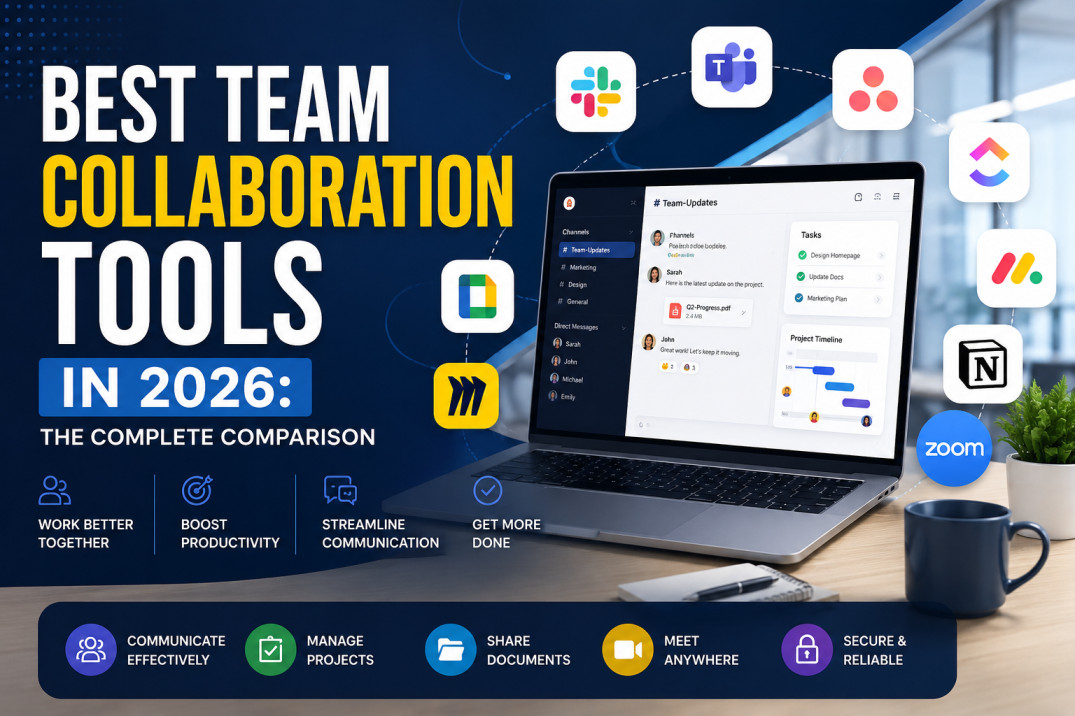
Choosing a team collaboration tool in 2026 is a different exercise than it was even two years ago. Every major platform — from Slack to Notion to Zoom — has spent the last eighteen months bolting on AI agents, credit-based usage limits, and consolidated “work platform” pricing. That means the old advice (“just pick Slack and Trello”) no longer tells the full story. The right tool now depends heavily on how your team communicates, how it tracks work, and how much you want to pay for AI features that used to be free add-ons.
This guide breaks down eleven of the most widely used team collaboration tools — covering current pricing, free plans, AI capabilities, integrations, and honest pros and cons — so you can match a tool to how your team actually works, not just how it’s marketed.
What’s in this guide
Best Team Collaboration Tools: Quick Picks
If you don’t have time to read the full breakdown, here’s the short version. Each pick below reflects the tool’s strongest, most defensible use case in 2026 — not just which one has the longest feature list.
Best Overall
ClickUp
The broadest feature set — tasks, docs, chat, and whiteboards — at one of the most competitive per-seat prices in the category.
Best for Communication
Slack
Still the gold standard for real-time channel-based messaging, threads, and third-party integrations.
Best for Project Management
Asana
Clean, structured workflows, strong portfolio and goal tracking, and a genuinely useful AI layer at the Starter tier.
Best for Remote Teams
Notion
A shared knowledge base plus lightweight project tracking that keeps distributed, async-first teams aligned without more meetings.
Best Free Option
Trello
A genuinely usable free plan — unlimited cards and boards, 10 collaborators, and built-in Butler automation — with no time limit.
Comparison Table: Team Collaboration Tools at a Glance
Pricing below reflects published starting rates for annual billing per user/month as of 2026. Monthly billing and enterprise tiers typically cost more — always confirm current pricing on the official site before purchasing, since AI credit systems and add-on pricing have been shifting throughout the year.
| Tool | Starting Price | Free Plan | Best For | AI Features |
|---|---|---|---|---|
| Slack | Pro from ~$7.25/user/mo | Yes (90-day history cap) | Real-time team chat | Slack AI: search, thread & channel summaries |
| Microsoft Teams | Bundled in Microsoft 365; Copilot add-on ~$30/user/mo | Yes (limited) | Microsoft-centric orgs | Microsoft 365 Copilot: meeting recaps, drafting |
| Asana | Starter ~$10.99/user/mo | Yes (Personal, up to 10 users) | Structured project management | Asana AI & AI Studio workflows |
| ClickUp | Unlimited ~$7/user/mo | Yes (unlimited members, capped storage) | All-in-one workspace | ClickUp Brain add-on (~$9/user/mo) |
| monday.com | Basic ~$9/seat/mo (3-seat min) | Yes (up to 2 seats) | Visual, customizable workflows | AI credits billed alongside seats |
| Notion | Plus ~$10/user/mo | Yes (generous, solo-friendly) | Docs, wikis & async knowledge base | Full Notion AI & Agent on Business tier ($20/user/mo) |
| Google Workspace | Business Starter ~$7/user/mo | No permanent free tier (trial only) | Email, docs & video for any org | Gemini built into Standard tier and above |
| Miro | Starter ~$8/user/mo | Yes (3 editable boards) | Visual whiteboarding & workshops | Miro AI credits (Sidekicks, diagramming) |
| Trello | Standard ~$5/user/mo | Yes (10 boards, 10 collaborators) | Simple Kanban task tracking | Atlassian Intelligence on Premium+ |
| Zoom Workplace | Pro ~$14/user/mo | Yes (40-min meeting cap) | Video meetings & remote calls | AI Companion included free on paid plans |
| Wrike | Team ~$10/user/mo | Yes (up to 5 users) | Mid-market work management | AI Essentials free; AI Elite on Business+ |
Detailed Tool Reviews
Here’s a closer look at each platform, including what it actually costs, what its AI features can and can’t do, and where it tends to fall short.
1. Slack — Best for Communication
From ~$7.25/user/mo
Best for: fast-moving teams that live in real-time chat
Slack remains the benchmark for channel-based messaging. Its combination of threads, huddles, Slack Connect for cross-company channels, and an enormous integration marketplace makes it the default choice for teams whose work depends on quick back-and-forth conversation rather than long-form documentation.
Pros
- Best-in-class search, threading, and channel organization
- Huge library of native and third-party app integrations
- Slack Connect enables secure external collaboration
Cons
- Free plan limits message history to the most recent 90 days
- Costs climb quickly for larger teams on Business+ and Enterprise
- Not built for structured project or task tracking
2. Microsoft Teams
Bundled with Microsoft 365
Best for: organizations already standardized on Microsoft 365
Teams isn’t sold as a truly standalone product for most businesses anymore — it’s the collaboration layer of Microsoft 365, tightly wired into Outlook, SharePoint, Word, Excel, and OneDrive. For companies already paying for Microsoft 365 Business or Enterprise licenses, Teams is effectively “free” on top of that investment, which is the strongest argument for choosing it.
Pros
- Deep native integration with the entire Microsoft 365 suite
- Strong enterprise-grade security, compliance, and admin controls
- Handles chat, video meetings, and file collaboration in one app
Cons
- Copilot AI features require a separate add-on, commonly priced around $30/user/month
- Interface can feel heavier and slower than dedicated chat tools
- Full value only shows up for teams already inside the Microsoft ecosystem
3. Asana — Best for Project Management
Starter from ~$10.99/user/mo
Best for: teams that want structured, visual project tracking
Asana strikes a strong balance between simplicity and power. List, board, timeline, and calendar views cover most planning styles, while Goals and Portfolios (on the Advanced plan) give leadership visibility across multiple projects without extra tooling.
Pros
- Clean, intuitive interface with multiple project views
- Strong reporting, goal tracking, and portfolio management on higher tiers
- Solid free plan for small teams (up to roughly 10 people)
Cons
- No single-seat paid plans — smaller teams pay for a minimum seat count
- Advanced automation and AI features require the Starter tier or higher
- Can feel overbuilt for very simple task lists
4. ClickUp — Best Overall
Unlimited from ~$7/user/mo
Best for: teams that want tasks, docs, chat, and whiteboards in one app
ClickUp’s pitch is “replace your other tools,” and for many teams it genuinely can. Tasks, docs, goals, dashboards, whiteboards, and chat all live in a single workspace, and the pricing stays competitive even as features expand. The tradeoff is complexity — there’s a real learning curve to configuring it well.
Pros
- Extremely broad feature set covering PM, docs, and collaboration
- Free plan supports unlimited members, unusual in this category
- Highly customizable views, statuses, and automations
Cons
- AI (ClickUp Brain) is a separate add-on billed per member, not included by default
- Free plan storage is capped and shared across the whole team
- Configuration depth can overwhelm smaller or non-technical teams
5. monday.com
Basic from ~$9/seat/mo
Best for: teams that want colorful, highly visual, customizable boards
monday.com’s board-based layout with color-coded status columns makes it especially popular with marketing, creative, and operations teams. It scales into a broader “work OS” with dedicated CRM and Dev products, though its AI is now metered through a credit system rather than a flat AI add-on.
Pros
- Highly visual, color-coded boards that are easy to scan at a glance
- Deep customization with columns, automations, and dashboards
- Companion products (CRM, Dev) extend the platform beyond core PM
Cons
- Free plan caps out at 2 seats; paid plans require a 3-seat minimum
- AI credits are billed as a separate line item alongside seats
- Pricing structure (seat brackets plus credits) can be harder to predict than flat per-seat rivals
6. Notion — Best for Remote Teams
Plus from ~$10/user/mo
Best for: distributed teams that rely on shared docs and async updates
Notion’s flexible blocks-and-databases model makes it equally good as a wiki, a lightweight project tracker, and a meeting-notes hub — which is exactly what distributed, async-first teams need. Instead of chasing updates across chat, remote teams can centralize decisions, specs, and status in one searchable workspace.
Pros
- Extremely flexible: docs, wikis, databases, and simple project boards in one tool
- Generous free plan for individuals and small solo workspaces
- Strong template ecosystem for onboarding, roadmaps, and knowledge bases
Cons
- Full Notion AI (including Notion Agent) is only available on the Business plan
- Not a dedicated real-time chat or video tool — pairs best with Slack or Teams
- Free plan caps file uploads and version history
7. Google Workspace
Business Starter from ~$7/user/mo
Best for: teams that want email, docs, and meetings from one trusted vendor
Google Workspace bundles Gmail, Docs, Sheets, Slides, Drive, and Meet under one subscription, with Gemini AI now built into the pricing rather than sold as a separate add-on. It’s less of a “project management” tool and more of a foundational productivity suite that other collaboration tools plug into.
Pros
- Real-time document collaboration is best-in-class and widely familiar
- Gemini AI is now included in Business Standard and above at no extra charge
- Reliable video meetings via Google Meet, integrated with Calendar
Cons
- No permanent free plan for businesses — only a trial
- Full Gemini features require Business Standard or above, not Starter
- Lacks native task/project management depth compared to dedicated PM tools
8. Miro
Starter from ~$8/user/mo
Best for: workshops, brainstorming, and visual/product planning
Miro’s infinite canvas is the closest thing to a shared physical whiteboard for distributed teams, and it’s become a genuine product-development platform with diagramming, prototyping, and AI-assisted “Sidekick” workflows layered on top.
Pros
- Best-in-class visual canvas for brainstorming and workshops
- Wide template library for retros, mapping, and planning sessions
- Strong integrations with Jira, Azure DevOps, and Asana on Business tier
Cons
- Free plan is limited to 3 editable boards, restrictive for ongoing team use
- AI usage is metered by monthly credits that reset and don’t roll over
- Not designed as a task-tracking or chat replacement
9. Trello — Best Free Option
Free plan; Standard from ~$5/user/mo
Best for: individuals and small teams who want simple Kanban boards
Trello’s free plan is one of the most genuinely usable in the category: unlimited cards, unlimited Power-Ups, and 10 boards for up to 10 collaborators, with no time limit. Its built-in Butler automation lets even free users cut down on repetitive manual work.
Pros
- Genuinely useful free-forever plan with no trial expiration
- Simple, visual Kanban interface with almost no learning curve
- Butler automation reduces manual card management even on lower tiers
Cons
- Free plan caps out at 10 boards and 10 collaborators per workspace
- Advanced views (Timeline, Table, Dashboard, Map) require Premium or Enterprise
- Lacks the depth needed for complex, multi-team project portfolios
10. Zoom Workplace
Pro from ~$14/user/mo
Best for: video-first teams and client-facing meetings
Zoom expanded well beyond meetings into “Workplace” — bundling Team Chat, Mail, Calendar, and whiteboarding around its core video product. For teams whose collaboration is meeting-heavy rather than chat-heavy, it remains a strong, reliable choice, and its AI Companion is included free rather than charged as an extra line item.
Pros
- Consistently reliable video quality and meeting performance at scale
- AI Companion (summaries, action items, chat drafting) included free on paid plans
- Bundles chat, mail, and calendar alongside its core meetings product
Cons
- Free Basic plan caps group meetings at 40 minutes
- Team Chat and docs are less mature than dedicated tools like Slack or Notion
- Deeper agentic AI features (ZoomMate) require a separate paid tier
11. Wrike
Team from ~$10/user/mo
Best for: mid-market teams that need approvals and resource management
Wrike sits between lightweight tools like Trello and heavyweight enterprise platforms. Its strength is process control — approval workflows, request forms, resource and workload views — which makes it a good fit for marketing, creative, and operations teams with formal review cycles.
Pros
- Strong approval workflows, request forms, and resource management on Business tier
- Free plan includes Gantt charts, unusual among free project tools
- Two-way Jira sync and broad integrations with Microsoft 365 and Google Workspace
Cons
- Seats are sold in fixed bands, so smaller teams often pay for unused capacity
- AI Elite features are now subject to monthly usage quotas
- Business-tier pricing is a noticeable jump from the Team plan
How to Choose the Right Team Collaboration Tool
With eleven strong options, the decision usually comes down to five practical questions rather than a single “best” answer:
- What’s your primary collaboration mode? If your team lives in real-time conversation, prioritize Slack or Teams. If it’s async and documentation-heavy, prioritize Notion or Google Workspace.
- Do you need task tracking, or just communication? Asana, ClickUp, monday.com, and Wrike are built for structured project work; Slack, Teams, and Zoom Workplace are not substitutes for a task tracker.
- How important is AI, and how is it priced? AI is rarely “free” in 2026 — it’s either bundled into a higher tier (Notion Business, Google Workspace Standard+) or billed as a metered add-on (ClickUp Brain, monday.com AI credits, Wrike AI Elite). Budget for AI separately from your base seat cost.
- What’s your real team size and seat structure? Watch for seat minimums (monday.com requires 3 seats on paid plans; Wrike sells in fixed bands) that can make small teams pay more per person than the advertised rate suggests.
- What do you already pay for? If you’re already on Microsoft 365 or Google Workspace, the built-in collaboration tools (Teams or Meet/Chat) are effectively free additions before you pay for a separate platform.
Rule of thumb: most teams end up running two tools, not one — a communication layer (Slack, Teams, or Zoom Workplace) paired with a work-tracking layer (Asana, ClickUp, monday.com, or Wrike). All-in-one platforms like ClickUp and Notion try to collapse that into a single subscription, which works well for smaller teams but can feel limiting once you need best-in-class video or messaging at scale.
2026 Team Collaboration Trends
AI moves from add-on to credit-metered utility
Flat-rate AI add-ons are giving way to credit systems (monday.com, ClickUp, Notion Agents, Wrike AI Elite) that charge based on actual usage rather than a fixed per-seat fee.
Agentic AI, not just chat assistants
Notion Agent, ZoomMate, and monday Vibe now execute multi-step tasks — building trackers, drafting docs, or generating apps — rather than just answering questions.
Consolidation into “work platforms”
Vendors increasingly bundle chat, docs, whiteboards, and task tracking into one subscription (ClickUp, monday.com, Notion) instead of selling narrowly focused tools.
AI bundled directly into core suites
Google folded Gemini into Workspace pricing and Zoom includes AI Companion free with paid plans — a shift away from separately priced AI add-ons for baseline features.
Free plans are getting more usable, not less
ClickUp and Trello both offer unlimited members or cards on their free tiers, competing harder for small teams and solo users before they ever hit a paywall.
Seat-plus-usage pricing is becoming the norm
Rather than one flat number, more platforms now combine a per-seat base price with a separate, usage-based AI or automation charge — making total cost harder to predict up front.
Frequently Asked Questions
Final Recommendations by Team Type
Startups & small teams (under 10 people)
Start with Trello or ClickUp’s free plans for task tracking and Slack’s free tier for chat. Upgrade to paid tiers only once you hit real limits, not preemptively.
Growing mid-size teams (10–50 people)
Asana or ClickUp for project management, paired with Slack for communication, is a proven combination that scales well without excessive per-seat cost.
Remote-first / distributed teams
Notion as a shared knowledge base and lightweight tracker, plus Zoom Workplace or Slack for synchronous conversation, minimizes meeting overload while keeping everyone aligned.
Design, product & creative teams
Miro for workshops and visual planning, combined with Asana or monday.com for execution, covers both the ideation and delivery sides of creative work.
Enterprises & regulated industries
Microsoft Teams or Google Workspace as the communication backbone, paired with Wrike or Asana Enterprise for approval-heavy, auditable project workflows.
Agencies & client-facing teams
Wrike or monday.com for structured client workflows and approvals, with Zoom Workplace handling client calls and meeting recaps via its built-in AI Companion.