

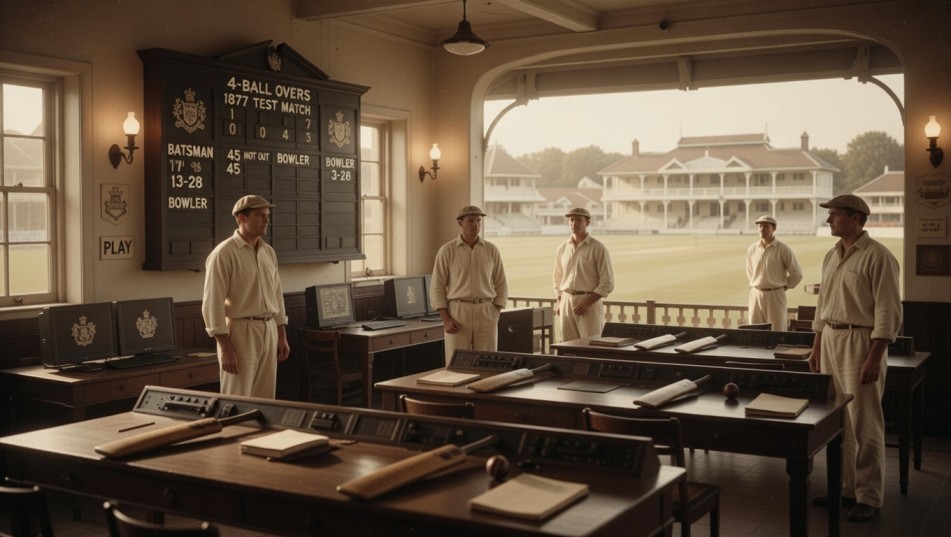
🏏 CRICKET HISTORY UNCOVERED · 2026
The surprising answer isn’t 6. From 4-ball overs to 8-ball experiments—here’s the complete history every cricket fan needs to know in 2026.
📅 Evolution of Test Cricket Overs · 1877–2026
Sources verified by cricket historians
ACS
ESPNcricinfo
MCC Archives
ICC
The 6-ball over is standard today—but it wasn’t always that way.
Table of Contents
ToggleAsk any cricket fan “How many balls in an over?” and they’ll instantly say six. It’s one of the most basic rules of the game. But here’s the fascinating truth: Test cricket originally used 4-ball overs, and over the decades, the number has shifted between 4, 5, 6, and even 8 deliveries depending on the country and the era [citation:1].
In fact, it wasn’t until 1979 that the entire cricketing world finally agreed on a universal standard. Before that, if you were watching a Test match in Australia in the 1920s, you’d see 6-ball overs. But if you tuned in during the 1940s, you’d count 8 balls between overs. Confused? You’re not alone [citation:3].
“Prior to the Laws of Cricket (1980 Code), law 17.1 did not explicitly specify the number of balls to be bowled in an over. It was typically agreed between captains before the toss.” — Association of Cricket Statisticians [citation:3]
Originally, it varied by country
The number of balls per over was a local decision—here’s how the major nations played.
England’s evolution
1880–1888: 4 balls
1889–1899: 5 balls
1900–1938: 6 balls
1939–1945: 8 balls (WWII era)
1946–present: 6 balls [citation:1]
→ England cricket archives
Australia’s long 8-ball era
1876–1888: 4 balls
1891–1920: 6 balls
1924–1978: 8 balls (for over 50 years!)
1979–present: 6 balls [citation:10]
→ ESPNcricinfo data
South Africa’s path
1888/89: 4 balls
1889–1898: 5 balls
1902–1936: 6 balls
1938–1957: 8 balls
1958–present: 6 balls [citation:6]
→ Read more
The great unification: 1979
For nearly a century, traveling cricketers had to adjust to local over lengths. Imagine an Australian batsman training on 8-ball overs, then touring England where overs were 6 balls! The turning point came in 1979, when the International Cricket Conference (now ICC) finally standardized the rule worldwide [citation:3].
- ✓ 1979/80 season: Australia switched from 8 to 6 balls per over
- ✓ New Zealand: Ended its 8-ball era the same year
- ✓ Pakistan: Followed suit after their 8-ball试验 (1974-1978)
- ✓ India, West Indies, Sri Lanka: Always used 6 balls [citation:8]
Why should you care in 2026?
The history of the over affects how we understand cricket records today.
Comparing eras
When you see bowling figures from 1930s Australia, remember: overs were 6 balls, but in the 1940s they became 8. Strike rates aren’t directly comparable without context [citation:10].
Record books
Some statistical anomalies exist because of over-length variations. The famous 8-ball overs in Australia produced different bowling workloads than in England [citation:3].
Cricket trivia
Impress your friends: “Did you know the first Test match in 1877 used 4-ball overs?” It’s a guaranteed conversation starter at any cricket gathering.
Complete historical breakdown
Balls per over in Test cricket by country and era [citation:3][citation:6]
Country
England
Australia
South Africa
New Zealand
Pakistan
India/West Indies
Original (1800s)
4 (1880-88)
4 (1876-88)
4 (1888/89)
6 (1895-96)
6 (1947-72)
Always 6
Mid-century
8 (1939-45)
8 (1936-78)
8 (1938-57)
8 (1937-44, 1968-79)
8 (1974-78)
6 (always)
Note: Some countries had brief experimental periods—see sources for full detail [citation:3]
What the historians say
Cricket’s governing bodies and historians weigh in.
The 1979 standardization was one of the most significant administrative changes in cricket history. Before that, first-class cricket in different countries was almost a different game.
In Australia, the 8-ball over was a beloved tradition for over 50 years. It changed the rhythm of the game and gave bowlers more opportunities per over.
The fascinating 8-ball experiment
🇦🇺 Australia (1936–1978)
Australia adopted the 8-ball over for over 40 years, except for Test matches against England (which remained 6 balls by agreement). This created the strange situation where Sheffield Shield games used 8-ball overs, but some Tests used 6 [citation:10].
🇳🇿 New Zealand (1968–1979)
New Zealand had two 8-ball periods: 1937-44 and 1968-79. The second era was particularly significant, lasting over a decade before aligning with global standards [citation:6].
🇵🇰 Pakistan (1974–1978)
Pakistan experimented with 8-ball overs for just four seasons—a relatively brief trial compared to Australia’s long affair with the format [citation:8].
Did you know?
Fascinating facts about over lengths
1877
The very first Test match (Australia vs England) was played with 4-ball overs [citation:1].
5 balls
England used 5-ball overs from 1889-1899. South Africa also had a 5-ball era in the 1890s [citation:6].