
⚖️ AMERICAN TECH · 2026
How the balance between government, corporations, and citizens is being rewritten—and what it means for everyone.
🗺️ THE LANDSCAPE
“A decade ago, tech shaped culture. Now it shapes power—and power is pushing back.”
Table of Contents
ToggleThe relationship between Silicon Valley and Washington has entered a new era. After years of self-regulation, platforms face real oversight. After years of ignoring government, tech giants are lobbying harder than anyone. And a new generation of companies is navigating this complex landscape. Welcome to the new American tech order.
⚖️
63%
of Americans want stricter tech regulation (Pew 2026)
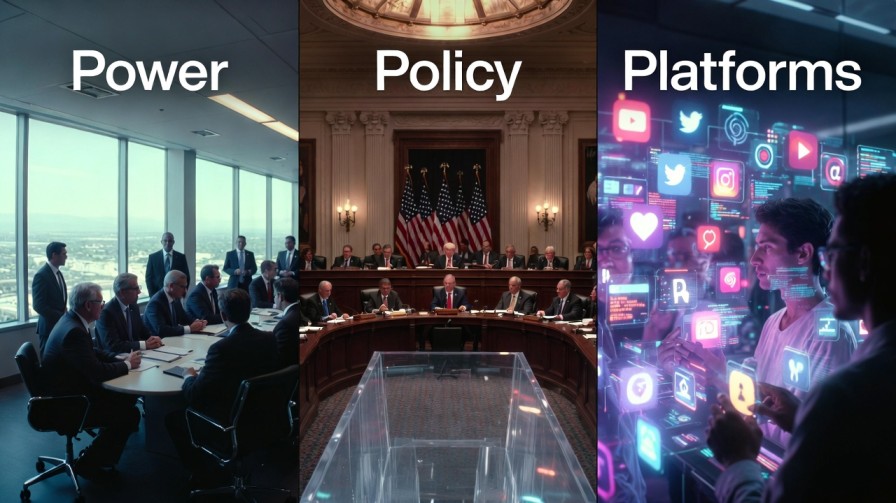
The Three Pillars of the New Landscape
🏛️
Power
Who really controls technology? The answer used to be the platforms. Now it’s a三角 between corporate boardrooms, government regulators, and the courts. Antitrust enforcement, content moderation rules, and national security concerns have fundamentally shifted the balance.
📜
Policy
From the CHIPS Act to the AI Bill of Rights, policy is no longer an afterthought. States are leading the way—California’s privacy law, Texas’s content moderation law, New York’s child safety rules. The federal government is playing catch-up, but the patchwork is real.
📱
Platforms
The platforms themselves are evolving. Some are retreating from news and politics. Others are embracing “platform cooperativism.” All are navigating a world where their every move is scrutinized. The era of growth at all costs is over.
Two Capitals, One Conversation
📍 WASHINGTON, DC
“Finally holding them accountable”
“For too long, tech wrote its own rules. That era is ending.” In DC, the mood is determined. Bipartisan legislation on AI, privacy, and kids’ safety is moving. Regulators are emboldened. The question is whether they can match the pace of innovation.
📍 SILICON VALLEY, CA
“Navigating complexity”
In Silicon Valley, the mood is more cautious. Companies are hiring armies of lawyers and policy experts. They’re building for compliance from day one. The freewheeling startup culture has given way to something more measured—and more defensive.
The new arithmetic of power
The Policy Battlegrounds of 2026
🤖
AI Regulation
The AI Bill of Rights is still voluntary, but 14 states have passed their own laws.
🔒
Privacy
Federal privacy law remains elusive. California’s CPRA is the de facto standard.
🧒
Kids Online
New York and Utah lead on child safety. Federal KOSA is pending.
📢
Content Moderation
Texas and Florida laws (partially upheld) force platforms to carry more speech.
💼
Antitrust
Google, Amazon, Meta, Apple all face major cases. Breakup is on the table.
🔌
Net Neutrality
Back from the dead? FCC is reclassifying broadband under Title II again.
The trust deficit
At the heart of the new landscape is a simple fact: Americans don’t trust tech companies anymore. Whether it’s privacy scandals, election interference, or mental health concerns, the halo is gone. Only 27% of Americans trust social media companies to do the right thing. This trust deficit is what’s driving policy, and it’s not going away.
How platforms are adapting
Some are leaning into trust and safety. Meta now spends more on content moderation than it did on Instagram acquisition. Google has delayed AI products to address ethical concerns. Others are fighting back—challenging laws in court and lobbying aggressively. The strategy varies, but the pressure is universal.
🛡️
“Trust is the new currency. We’re spending heavily to earn it.”
The states as laboratories
With federal gridlock, states are where the action is. California’s privacy law has become the de facto national standard. Texas and Florida are testing the limits of content moderation. New York is protecting kids online. The result is a patchwork that tech companies hate—but it’s also creating real-world experiments that will inform future federal policy.
The Brussels effect, American style
Europe’s GDPR and Digital Services Act set the global standard. But now American policymakers are learning from Brussels—and adapting. The “California effect” is real: what happens in the largest U.S. state often becomes the national norm. The question is whether the U.S. will eventually pass comprehensive federal legislation, or continue with state-by-state experimentation.
2030: What the landscape becomes
By 2030, experts predict a settled—but not static—landscape. Federal privacy law is likely. AI regulation will exist, though its shape is debated. Antitrust cases will have concluded, possibly breaking up some companies. The relationship between power, policy, and platforms will be more mature, more adversarial, and more complex. The wild west is over. The era of governance has begun.
❝ The new American tech landscape isn’t about winners and losers. It’s about figuring out, in real time, how to integrate the most powerful tools ever created into a democratic society. That’s the work of a generation. ❞
— Dipayan Ghosh, Harvard Kennedy School, 2026
🗺️ The New American Tech Landscape: Key Forces
DOJ Antitrust Division
State Attorneys General
California Privacy Agency
European Commission (DSA)
Tech Lobby Groups
Digital Rights Advocates
Labor Unions
Consumer Advocacy
Civil Rights Organizations