
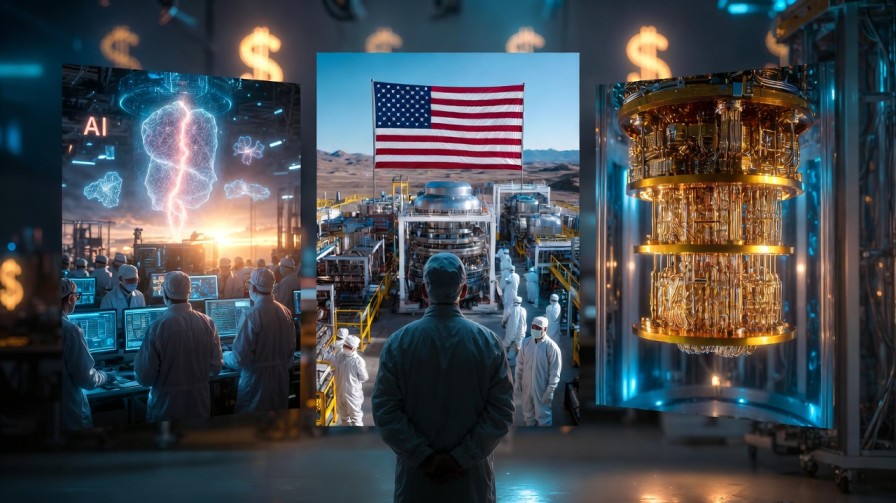

💰 NATIONAL DILEMMA · 2026
AI dominance, chip independence, and the next internet—America’s choices today will determine economic leadership for decades.
🤔 THE QUESTION
“Who will build the critical technology of the next decade—and on whose terms?”
Table of Contents
ToggleThe United States faces a series of interconnected trillion-dollar questions. Will we lead the AI revolution or cede ground? Can we rebuild semiconductor independence? Who wins the quantum computing race? The answers will shape American prosperity, security, and global standing for generations.
💲
$1.2T
estimated annual GDP at stake by 2035
The Three Trillion-Dollar Questions
Question 1: AI Dominance
Will American companies maintain their lead in artificial intelligence, or will China and Europe capture the next wave? The U.S. currently leads in model development, but China dominates in AI deployment and data. The winner could capture trillions in productivity gains.
Question 2: Semiconductor Independence
Can the U.S. rebuild its chip manufacturing capacity after decades of offshoring? The CHIPS Act was a down payment, but Taiwan still produces 92% of advanced chips. A conflict would cripple the global economy. The question: can we become self-sufficient?
Question 3: Quantum Supremacy
Quantum computing will eventually break current encryption and revolutionize drug discovery, materials science, and logistics. The U.S., China, and Europe are racing. The first to achieve practical quantum advantage wins a multi-trillion-dollar prize.
Two Views on the Question
📍 SILICON VALLEY · OPTIMIST
“America always innovates its way through”
“We have the venture capital, the research universities, and the entrepreneurial culture.” The optimist case: American dynamism will outrun any competition. Government should get out of the way and let innovation flourish.
📍 WASHINGTON DC · REALIST
“This time is different—we need strategy”
The realist counters that China plays by different rules—state-directed capital, industrial policy, and intellectual property acquisition. The U.S. needs a coordinated strategy, not just faith in markets.
The stakes, quantified
Breaking Down the Questions
AI Talent
China graduates 5x more STEM PhDs. Immigration policy is key.
Chip Independence
TSMC’s Arizona plants are ramping, but talent shortage looms.
Quantum Race
IonQ, PsiQuantum, and Google lead, but China is investing heavily.
6G & Telecom
Huawei still leads in 5G patents. 6G is the next battleground.
Energy Tech
Battery and grid technology are strategic imperatives.
Space
Starlink leads, but China is building its own constellation.
The China factor
You can’t answer the trillion-dollar question without talking about China. Their industrial policy is coordinated, well-funded, and patient. They’re not trying to beat us in next quarter’s earnings—they’re thinking in decades. The U.S. response has been piecemeal: the CHIPS Act, the Science Act, export controls. But is it enough? And can a free-market democracy match the focus of an authoritarian state?
What should government do?
The debate is fierce. Some argue for industrial policy—direct investment, tax credits, and protected markets. Others say government should fund basic research and get out of the way. The reality is we’re doing both, but without a clear strategy. The next administration will have to answer: is tech leadership a matter of national security, and if so, what are we willing to invest?
🏛️
“The CHIPS Act was a start. But we need a sustained, multi‑decade commitment.”
Can companies do it alone?
American companies are investing heavily—Microsoft, Google, Amazon, and others spent $238B on R&D last year. But shareholder pressure means they optimize for short-term returns. Basic research, long-shot bets, and infrastructure don’t always fit that mold. Public-private partnerships are emerging, but they’re still experimental.
The talent bottleneck
None of this works without people. The U.S. faces a critical shortage of engineers, data scientists, and skilled technicians. Immigration restrictions have made it harder to attract global talent. Meanwhile, K-12 STEM education lags. The trillion-dollar question may ultimately be answered in classrooms, not boardrooms.
2035: Three possible futures
Scenario A: America leads in AI, chips, and quantum—economic growth accelerates, and we maintain global influence. Scenario B: We share leadership with China—a bipolar tech world emerges, with competing standards and spheres of influence. Scenario C: We fall behind—economic stagnation, security risks, and a diminished role in the world. The choices we make today determine the outcome.
❝ The trillion-dollar question isn’t really about technology. It’s about whether a free society can make long-term decisions in a short-term world. That’s the test we face. ❞
— Margaret O’Mara, tech historian, 2026
📋 The Decisions That Will Shape the Answer
AI regulation framework
Export control policy
STEM immigration reform
Basic research funding
Quantum initiative
6G spectrum allocation
Energy policy for data centers