
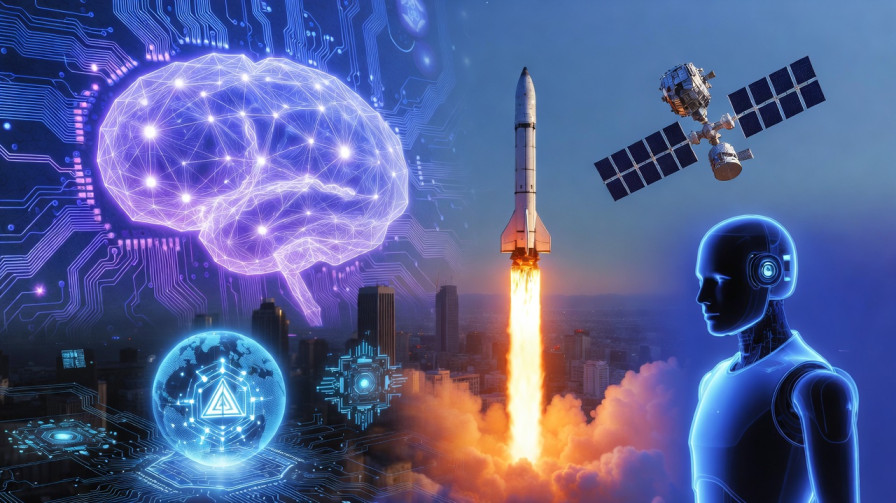
In 2026, “emerging technology” means more than just buzzwords—it represents a fundamental shift in how Americans live, work, and compete globally. These trends are moving from labs and niche communities into mainstream markets and national policy.
From Silicon Valley to Wall Street, and from Washington D.C. to university campuses, Americans are closely monitoring these advancements for their profound economic, societal, and strategic implications.
🚀 Top Emerging Tech Trends for 2026
Web3 & DeFi 2.0
The evolution beyond cryptocurrency into decentralized finance, identity, and governance, powered by more scalable and energy-efficient blockchains.
AI Agents & Hyper-Automation
Autonomous AI systems that execute complex tasks, make decisions, and interact with other software and humans—moving beyond simple chatbots.
Space Tech & Satellite Internet
Low-earth orbit (LEO) satellite mega-constellations, space tourism, and in-orbit manufacturing are becoming commercial realities.
Quantum Computing
Moving from experimental to early practical applications in drug discovery, cryptography, and complex system optimization.
Extended Reality (XR)
Blended AR, VR, and Mixed Reality environments for enterprise training, remote collaboration, and immersive retail.
Green & Climate Tech
Breakthroughs in energy storage, carbon capture, smart grids, and sustainable materials to address climate challenges.
Biotech & Longevity
Gene editing, personalized medicine, and aging-reversal therapies are moving from research labs to clinical trials.
Robotics & Humanoid AI
General-purpose robots and humanoid assistants designed for logistics, manufacturing, and eventually, home and service tasks.
📈 Why Americans Are Closely Watching These Trends
Economic Impact
Collectively trillions in potential GDP growth, new industries, and market disruption.
Job Creation & Disruption
Millions of new roles in AI, cybersecurity, and engineering, while automating others.
National Competitiveness
A global race for tech leadership, especially against China and the EU.
Consumer Adoption
How quickly these technologies integrate into daily American life.
🏢 Real-World Use Cases & Early Adoption
🏦 Finance & Payments
DeFi for instant cross-border settlements. AI for fraud detection and personalized wealth management.
🏥 Healthcare
AI diagnostics, biotech for personalized cancer vaccines, and VR for surgical training and therapy.
🛡️ Defense & Aerospace
Quantum-resistant encryption, autonomous drones, and LEO satellites for global intelligence and connectivity.
🏙️ Smart Cities
IoT networks for traffic and energy management, and robotics for infrastructure inspection and maintenance.
📚 How to Stay Ahead of These Tech Trends
- Commit to Continuous Learning: Use platforms like Coursera, edX, or industry-specific certifications to understand the basics of AI, blockchain, or data science.
- Follow the Money & Policy: Monitor SEC filings for tech giants, track venture capital funding rounds (Crunchbase), and follow key US legislation like the CHIPS Act or AI policy frameworks.
- Upskill Strategically: For professionals, develop adjacent skills—learn prompt engineering for AI, understand smart contracts for Web3, or study data privacy laws.
- Follow US Innovation Leaders: Track key figures and labs from companies like Google (Quantum AI), SpaceX (Starlink), and OpenAI, as well as DARPA and national labs.
- Test Early Tools (Safely): Experiment with public AI models, try a Web3 wallet for digital art, or use AR apps to understand the user experience firsthand.
- Build Your Network: Attend tech meetups (virtual or in-person), follow niche subreddits and Discord channels, and connect with builders in these spaces.
- Think in Scenarios: Regularly ask “What if?” for your industry. What if quantum breaks encryption in 5 years? What if humanoid robots cut logistics costs by 70%?
⚖️ Opportunities vs. Challenges
✅ Major Opportunities
- Economic Growth: Creation of entirely new markets and revenue streams.
- Solving Grand Challenges: Climate change, disease, and resource scarcity.
- Enhanced Human Capability: AI as a co-pilot, biotech for longer healthspans.
- Global Leadership: For the US to set standards and export innovation.
- Democratization: DeFi for financial access, satellite internet for connectivity.
❌ Key Challenges & Risks
- Regulatory Uncertainty: Lack of clear rules for AI, crypto, and data privacy.
- Security Threats: Quantum hacking, deepfakes, and decentralized cybercrime.
- Adoption Barriers: High costs, infrastructure needs, and the digital skills gap.
- Ethical Dilemmas: Bias in AI, genetic editing, autonomous weapons, and job displacement.
- Market Consolidation: Risk of power concentrating in a few tech behemoths.
❓ FAQs: Emerging Tech Trends in 2026
1. Which trend has the most immediate impact on everyday Americans?
AI Agents & Automation. From smarter customer service and personalized content to productivity tools at work, AI integration is becoming ubiquitous, changing daily interactions and job tasks.
2. Is Web3/DeFi still relevant after the crypto crashes?
Yes, profoundly. The focus has shifted from speculative assets to underlying infrastructure—like scalable blockchains, decentralized identity, and tokenization of real-world assets (RWAs), which large financial institutions are now exploring.
3. How is the US government involved in these trends?
Heavily, through funding (CHIPS & Science Act, IRA), regulation (SEC on crypto, FDA on biotech), and defense contracts (Space Force, DARPA). The government is a major driver and customer for space, quantum, and AI tech.
4. What’s the best way for a beginner to start learning about these technologies?
Pick one trend that aligns with your interests or career. Use free resources (YouTube explainers, MOOC introductory courses) and follow 2-3 reputable news sources dedicated to that niche (e.g., TechCrunch for startups, MIT Tech Review for analysis).
5. Are these trends creating or destroying more jobs in the USA?
In the short term, both. They are destroying repetitive, routine jobs while creating high-skill roles in engineering, data science, and cybersecurity. The net effect depends on successful workforce retraining and education adaptation.
6. When will quantum computing become a practical threat to current encryption?
Most experts estimate “cryptographically relevant” quantum computers are 5-10 years away. However, the transition to “quantum-resistant” encryption must start now, as data harvested today could be decrypted later.
7. Which trend is the most overhyped for 2026?
Some analysts believe the timeline for widespread, consumer-ready AR/VR glasses is longer than marketed due to hardware and social adoption barriers. The enterprise use cases will lead.
8. How can I invest in these trends as an individual?
(Not financial advice) Options include broad-based tech ETFs, thematic ETFs focused on AI or robotics, or stocks in large “enabler” companies (e.g., semiconductor makers). For the adventurous, some explore early-stage startups via regulated crowdfunding platforms. Always do your own research (DYOR).
Ready to Dive Deeper into the Future?
Stay ahead of the curve. Get monthly insights on US tech trends, policy shifts, and breakthrough innovations delivered to your inbox.
The Future is Being Built Now
The top emerging tech trends of 2026 represent more than isolated gadgets—they are interconnected forces reshaping the American economy, society, and its position in the world. From decentralized networks to outer space, the pace of change is accelerating.
The United States, with its unique blend of venture capital, top-tier research universities, and a culture of entrepreneurship, is poised to lead this next wave—but success depends on informed participation, smart regulation, and inclusive opportunity. The future isn’t just something we watch; it’s something we build.